
Struggling to machine stainless steel without breaking tools? This tough material demands a specialized end mill. The right choice will save you time, money, and a lot of frustration.
The best end mill for stainless steel uses a micro-particle carbide substrate, a heat-resistant coating like AlCrN, and a variable helix geometry. This combination manages extreme heat, resists chipping from high cutting forces, and prevents the chatter that ruins surface finishes and destroys tools.
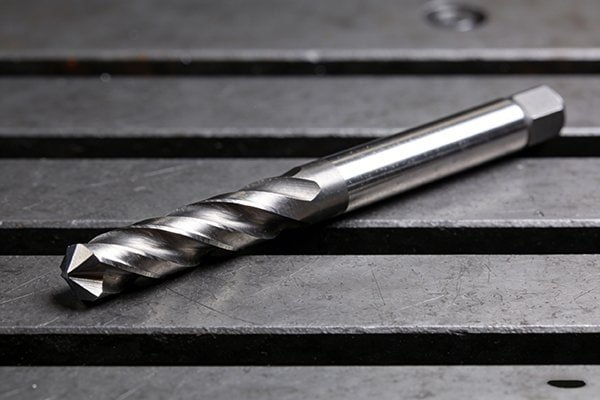
Choosing the right tool feels like navigating a minefield. One wrong step, and you've got a broken end mill and a scrapped part. But it doesn't have to be that complicated. I've spent years helping machine shops solve this exact problem. We're going to break down the selection process, step-by-step, so you can pick a winner every single time. Let's dive in and turn this challenging material into a routine job.
First, Why Does Stainless Steel Demand a Specialized End Mill?
Does a standard end mill stand a chance against stainless steel? The short answer is no. This material's unique properties will quickly destroy a tool that isn't built for it.
Stainless steel isn't like other metals. Its high strength, poor heat conductivity, and tendency to work-harden create a perfect storm for tool failure. A specialized end mill is designed with the right material, geometry, and coating to survive these brutal cutting conditions.
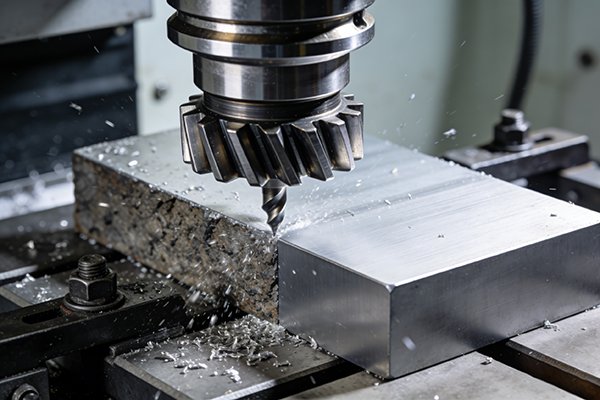
When I first started in this business, I saw many shops try to use their general-purpose end mills on stainless steel. The results were always the same: broken tools, terrible surface finishes, and a lot of wasted time. To understand why a special tool is necessary, you have to understand the enemy. Stainless steel has three main characteristics that make it so difficult to machine.
First is work hardening. As you cut it, the material in front of the cutting edge actually gets harder1. This means that with every rotation, the tool is trying to cut a surface that is harder than the last. A standard tool will dull almost instantly, which just makes the work hardening even worse.
Second is its low thermal conductivity. Unlike aluminum or steel, stainless steel doesn't let heat escape easily2. All that cutting energy turns into heat, and it gets trapped right at the tool's cutting edge. This intense heat can soften the carbide and cause the edge to fail catastrophically.
Finally, it's gummy and ductile. This leads to a phenomenon called "built-up edge3," where tiny pieces of the stainless steel literally weld themselves to the tool's cutting edge. This ruins the tool's geometry, causes a terrible surface finish, and can eventually lead to the tool breaking. A specialized end mill is designed from the ground up to combat these three problems.
What Grade of Carbide Prevents the Edge from Chipping or Deforming?
Is your end mill's cutting edge chipping under pressure? This leads to scrapped parts and wasted money. The solution is choosing a carbide grade with superior strength and toughness.
You need to use a tool made from a micro-particle or sub-micron grain carbide4. This advanced material provides the perfect blend of hardness to resist wear and toughness to prevent chipping. It stands up to the intense cutting forces of stainless steel without deforming or breaking down.
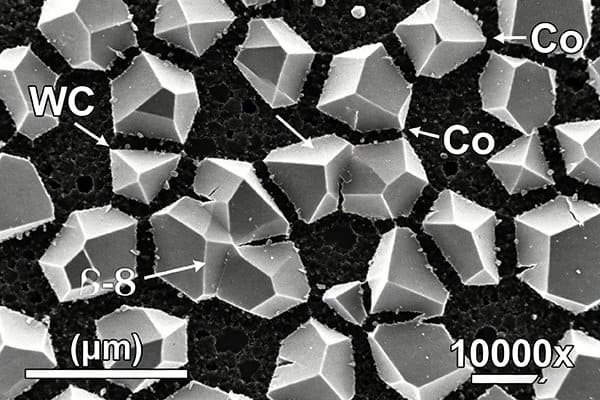
Not all carbide is created equal. Think of it like concrete. You can have concrete made with large gravel, or you can have it made with fine sand. The one with fine sand will be much denser and stronger. It's the same with carbide. Standard carbide grades use larger tungsten carbide grains. They work fine for softer materials, but they have tiny gaps and weak points. When you put them up against the high cutting forces of stainless steel, those weak points are where micro-chips start to form.
A micro-particle carbide grade, on the other hand, uses extremely small grains. These grains are packed together much more tightly, creating a material that is incredibly dense and uniform. This gives it two critical properties:
- High Hardness: It can withstand the abrasive nature of stainless steel without dulling quickly.
- High Transverse Rupture Strength5: This is just a technical way of saying it's very tough and resists bending and chipping. It can handle the high pressure at the cutting edge without fracturing.
At our facility, we insist on using premium micro-particle tungsten steel from top suppliers. We know that the foundation of a great end mill is the material itself. Without this tough and resilient carbide, even the best geometry and coating will fail. It's the core strength that allows the tool to survive the fight.
How Does a Variable Helix Design Cancel Out Chatter and Vibration?
Do you hear that awful screeching sound of chatter when you machine? That vibration ruins your finish, causes tool breakage, and leads to inaccurate parts. A variable helix design is the answer.
A variable helix, or unequal flute spacing, is a design that breaks up the harmonic vibrations that cause chatter6. By changing the timing of each flute's cut, it prevents a destructive rhythm from building up, resulting in a smoother, quieter cut and much longer tool life.
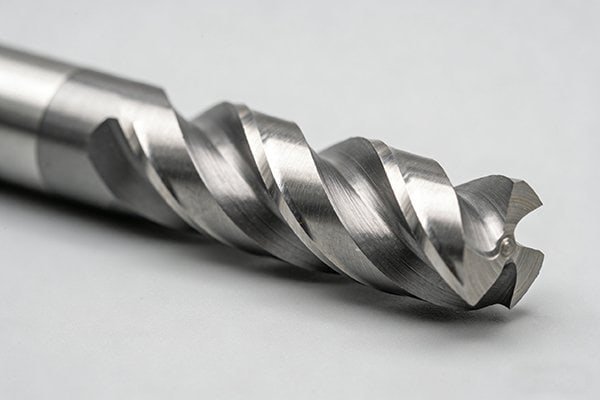
Chatter is the biggest enemy of a good surface finish. You can think of a standard end mill like a bell. If you tap it at just the right frequency, it will start to ring loudly. In machining, this "ringing" is chatter. A standard end mill with evenly spaced flutes (for example, four flutes all at a 30° helix) taps the workpiece at a very regular, rhythmic interval. If that rhythm matches the natural frequency of the tool, the holder, or the machine, it starts to vibrate violently.
A variable helix design completely disrupts this rhythm. Instead of having four flutes at 30°, you might have flutes at 38°, 40°, 42°, and 44°. Each cutting edge engages the material at a slightly different time and with a slightly different shearing action. This irregularity makes it impossible for the destructive harmonic vibration to build up. The cut becomes stable and quiet.
Beyond just stopping chatter, a high helix angle (typically between 38° and 45°)7 is also great for stainless steel. The steep angle creates a better shearing action, which helps to lift the gummy chips up and out of the cut. This improved chip evacuation is critical for preventing chips from packing in the flutes, which is a common cause of tool failure in stainless steel. It’s a simple change in geometry that solves two of the biggest problems at once.
Which Coating Best Deflects the Intense Heat of Stainless Steel Machining?
Is heat killing your end mills? When machining stainless steel, the intense heat generated at the cutting edge can soften the carbide and cause it to fail in seconds. The right coating acts as a shield.
The best choice is a modern coating like AlCrN (Aluminum Chromium Nitride) or an advanced AlTiN8. At high temperatures, these coatings form a micro-thin, ultra-hard layer of aluminum oxide9. This layer acts as a thermal barrier, deflecting heat away from the tool and into the chip.
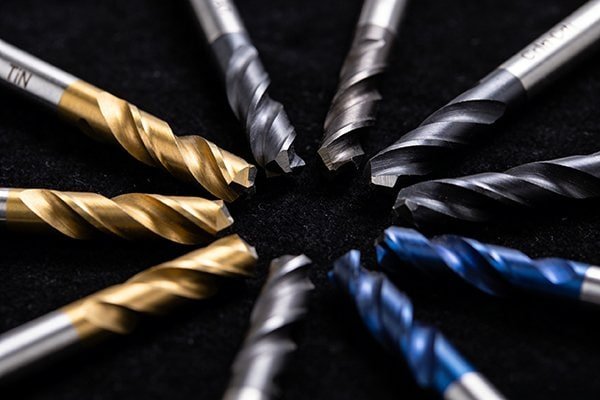
Remember how we talked about stainless steel's low thermal conductivity? All the heat from cutting gets trapped right at the tip of your tool. The job of a coating isn't just to make the tool harder; its main job here is to manage that heat. Think of it like the heat shield on a spacecraft re-entering the atmosphere.
Older coatings like TiN (the gold-colored one) can't handle the high temperatures of stainless steel machining. They break down quickly. Modern coatings like AlCrN are designed specifically for these high-heat applications. The magic is in how they react to heat. As the cutting edge gets hot, the aluminum in the coating combines with oxygen in the air to form a microscopic layer of aluminum oxide (which is essentially a type of ceramic).
This ceramic layer does three amazing things:
- It's a fantastic insulator. It creates a thermal barrier that prevents heat from soaking into the carbide substrate, keeping the tool hard and strong.
- It's incredibly hard. This protects the cutting edge from abrasive wear.
- It's very slick. This lubricity prevents the gummy stainless steel chips from sticking to the tool, which stops built-up edge from forming.
The goal is to force the heat to leave with the chip. A good coating ensures that the heat flows into the chip, which then gets carried away from the cutting zone. This keeps the tool cool, sharp, and cutting for much longer.
How Do You Pair Your End Mill with the Right Speeds and Feeds Strategy?
Even the perfect tool will fail if you run it with the wrong parameters. This leads to broken tools, wasted material, and lost time. You must match your flute count and strategy to the job.
For roughing, use a 4-flute end mill for its strength and run it with moderate speeds and a higher feed rate. For finishing or deep slotting, switch to a 3-flute tool for better chip evacuation, using higher speeds and a lower feed rate for a better finish.

The number of flutes on your end mill is directly tied to your machining strategy. You can't just grab any tool and hope for the best. You need to think about what you are trying to accomplish: removing a lot of material quickly (roughing) or creating a beautiful surface finish (finishing).
For Roughing, your main goal is a high material removal rate.
- Tool: A 4-flute end mill is ideal10. The extra flutes mean the tool has a larger, stronger core. This added rigidity allows it to withstand the heavy cutting forces of deep cuts without breaking.
- Strategy: You want to run at a more conservative RPM to keep heat under control, but with a high feed per tooth. This creates a thick chip, and that thick chip is what pulls the heat away from the tool.
For Finishing or Deep Slotting, your main goal is a great surface finish and avoiding chip packing.
- Tool: A 3-flute or even a 2-flute end mill is much better. The fewer flutes mean there are much larger "gullets" or spaces between the cutting edges. This space is critical for evacuating the gummy stainless steel chips. If the chips pack in the flute, the tool will overheat and fail instantly.
- Strategy: Here, you can increase the RPM to get a better surface finish, but you'll use a lower feed rate.
Here is a simple table to help you remember:
| Machining Stage | Flute Count | Why? | Speed & Feed Strategy |
|---|---|---|---|
| Roughing | 4-Flute | Stronger core for rigidity in heavy cuts. | Lower RPM, Higher Feed Rate |
| Finishing/Slotting | 3-Flute (or 2) | Larger gullets for better chip evacuation. | Higher RPM, Lower Feed Rate |
Remember, these are starting points. Always consult your tool manufacturer's recommendations and be prepared to adjust your parameters based on the sound of the cut and the condition of your chips.
So, What's Your Final Checklist Before Hitting 'Cycle Start'?
You've chosen your tool and set your parameters, but one small oversight can still be costly. A broken tool or a scrapped part is always frustrating. Run through this quick final checklist.
Before you begin, confirm you have a micro-particle carbide end mill with a coating like AlCrN. Check that your flute count matches the operation. Ensure your tool holder is rigid and that you have a powerful flood coolant system ready to go.
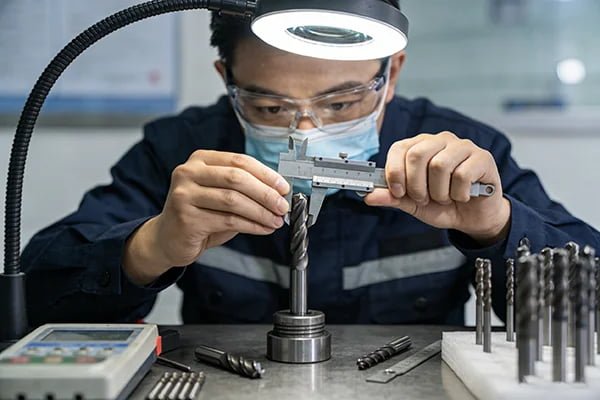
I always tell my customers to take 30 seconds to double-check everything before they press the green button. That small pause can save hours of headache. It's like a pilot's pre-flight checklist. It ensures every critical system is ready for the demanding task ahead. Here’s what you should be looking at:
-
The End Mill Itself:
- Carbide: Is it a micro-particle grade designed for tough alloys?
- Geometry: Does it have a variable or high helix design to fight chatter?
- Coating: Is it a modern, high-heat coating like AlCrN or AlTiN?
- Flute Count: Are you using a 4-flute for roughing or a 3-flute for finishing?
-
The Setup:
- Tool Holder: Is the tool held in a high-quality, rigid holder (like a shrink-fit, hydraulic, or high-performance collet chuck)? A weak grip is a primary cause of chatter and tool failure.
- Stick-Out: Is the tool sticking out of the holder as little as possible? The longer the stick-out, the more likely it is to vibrate.
-
The Process:
- Coolant: Is your flood coolant aimed directly at the cutting zone with high pressure and volume11? For stainless steel, coolant isn't optional. It's essential for cooling, lubrication, and chip evacuation.
- Parameters: Are your speeds and feeds set to a conservative starting point from the tool supplier? You can always optimize for speed later, but start safely.
Running through this mental checklist ensures that your excellent tool choice is supported by a solid process, giving you the best possible chance for success.
Conclusion
Choosing the right end mill for stainless steel isn't magic. It's about matching the carbide, geometry, and coating to the material's unique challenges. Get these right, and you'll succeed.
"Secrets of CNC machining of high hardness stainless steel ...", https://jlccnc.com/blog/high-hardness-stainless-steel-cnc. A machining or materials source should explain work hardening in stainless steels as plastic deformation that increases local hardness ahead of or near the cutting edge during machining; this supports the mechanism but not the severity in every cutting condition. Evidence role: mechanism; source type: education. Supports: During cutting, stainless steel can work-harden so that the material near the cutting edge becomes harder.. Scope note: The degree of work hardening depends on stainless grade, tool condition, cutting speed, feed, and coolant use. ↩
"Material Properties: 304 Stainless (UNS S30400)", https://trc.nist.gov/cryogenics/materials/304Stainless/304Stainless_rev.htm. A materials database or engineering reference should show that stainless steels have lower thermal conductivity than many plain carbon steels and aluminum alloys, supporting the statement that heat dissipates less readily during machining; this is a comparative property, not a direct measurement of a specific cutting operation. Evidence role: mechanism; source type: institution. Supports: Stainless steel has relatively low thermal conductivity, so heat does not escape from the cutting zone easily.. Scope note: Thermal conductivity varies by stainless grade and temperature, and machining heat distribution also depends on speed, feed, tool geometry, and coolant. ↩
"Effect of Built-Up Edge Formation during Stable State of Wear ...", https://pmc.ncbi.nlm.nih.gov/articles/PMC5706177/. A machining reference should define built-up edge as workpiece material adhering or welding to the cutting tool under certain cutting conditions, and should note that ductile metals can be susceptible; the source may describe the phenomenon generally rather than stainless steel exclusively. Evidence role: definition; source type: education. Supports: Built-up edge occurs when workpiece material adheres to the cutting edge and can degrade finish and tool performance.. Scope note: General built-up-edge mechanisms apply across ductile metals, but the likelihood in stainless steel depends on grade and cutting conditions. ↩
"Wear Characteristics of WC-Co Cutting Tools Obtained by the ...", https://pmc.ncbi.nlm.nih.gov/articles/PMC12387649/. A cemented-carbide materials source should explain that fine-grain or submicron tungsten carbide grades are used to increase hardness and edge strength while maintaining toughness for cutting tools; the source supports the material rationale but not any specific brand or product. Evidence role: expert_consensus; source type: paper. Supports: Micro-particle or sub-micron carbide is an appropriate substrate choice for end mills cutting stainless steel because it balances hardness and toughness.. Scope note: Optimal carbide grade depends on cobalt content, binder chemistry, grain size distribution, and the operation being performed. ↩
"Understanding Cemented Carbide", https://www.precisionbyhyperion.com/resources/understandingcemented-carbide/. A cemented-carbide technical reference should define transverse rupture strength as a bending-strength measure used for brittle tool materials and should relate higher TRS to resistance to fracture under cutting loads; it does not alone predict tool life in every machining setup. Evidence role: definition; source type: research. Supports: High transverse rupture strength indicates toughness or bending-fracture resistance relevant to chipping resistance in carbide end mills.. Scope note: TRS is one mechanical property and must be considered alongside hardness, fracture toughness, coating, geometry, and cutting conditions. ↩
"Chatter Stability of Machining Operations", https://academy.cba.mit.edu/classes/computer_machining/chatter.pdf. A machining-dynamics source should describe chatter as a self-excited vibration related to regenerative or harmonic effects and show that variable-pitch or variable-helix cutters can disrupt periodic excitation and improve stability; this supports the mechanism in general, not guaranteed performance for a specific tool. Evidence role: mechanism; source type: paper. Supports: Variable helix or unequal flute spacing can reduce chatter by disrupting regular vibration excitation.. Scope note: Chatter reduction depends on the complete system, including tool overhang, holder, spindle, machine stiffness, and cutting parameters. ↩
"3/8" 3 Flute Single End Carbide End Mill 40° Degree Helix ...", https://villageofgreenwoodlake.gov/products/38-3-flute-single-end-carbide-end-mill-40-degree-helix-stub/221087954/. A cutting-tool or machining reference should indicate that higher-helix end mills provide a stronger shearing action and can improve chip evacuation in certain materials; the 38°–45° range should be treated as an industry design range rather than a universal rule. Evidence role: general_support; source type: education. Supports: High-helix end mills in the approximate 38°–45° range are commonly used to improve shearing and chip evacuation in stainless steel machining.. Scope note: The exact optimal helix angle depends on tool diameter, flute count, stainless grade, axial engagement, and machine rigidity. ↩
"Mechanical, oxidation, and cutting properties of AlCrN ...", https://www.sciencedirect.com/science/article/abs/pii/S0257897222000159. A coating-materials paper should support that AlCrN and AlTiN-family PVD coatings are used for high-temperature cutting because of oxidation resistance, hot hardness, and wear resistance; this supports coating suitability generally, not superiority in every stainless-steel operation. Evidence role: expert_consensus; source type: paper. Supports: AlCrN and advanced AlTiN coatings are suitable high-heat coating choices for stainless steel end mills.. Scope note: Performance depends on coating architecture, deposition method, substrate, cutting speed, coolant strategy, and workpiece grade. ↩
"High-Temperature Oxidation and Wear Resistance of ...", https://www.mdpi.com/2079-4991/15/7/503. A surface-engineering source should explain that aluminum-containing nitride coatings such as AlTiN or AlCrN can form protective alumina-rich oxide scales at elevated temperatures, contributing to oxidation resistance and thermal-barrier behavior; the source supports the mechanism but may not use the article's phrase “micro-thin.” Evidence role: mechanism; source type: paper. Supports: AlCrN and AlTiN coatings can form an aluminum-oxide layer at high temperatures that helps protect the cutting tool.. Scope note: The composition and continuity of the oxide layer depend on temperature, oxygen availability, coating composition, and cutting environment. ↩
"From Roughing to Finishing: Which Type of End Mill Do I ...", https://nv-tool.com/from-roughing-to-finishing-which-type-of-end-mill-do-i-need-for-each-step-of-my-project/. A milling reference should explain that increasing flute count generally increases core strength and can support heavier side-milling or roughing cuts, while reducing flute space for chip evacuation; this contextual support does not prove that four flutes are ideal for all stainless roughing operations. Evidence role: general_support; source type: education. Supports: A four-flute end mill is commonly suitable for roughing because added flutes and core mass increase rigidity, although chip evacuation must be managed.. Scope note: The ideal flute count depends on tool diameter, engagement, slotting versus profiling, coolant, chip evacuation, and the stainless grade. ↩
"How scCO₂ + MQL Is Extending Tool Life in Stainless ...", https://www.fusioncoolant.com/blog/how-scco-mql-is-extending-tool-life-in-stainless-steel-machining-by-over-300. A machining or manufacturing-engineering source should support that coolant delivery in stainless-steel cutting helps remove heat, reduce friction, and flush chips from the cutting zone; the need for high pressure and volume is application-dependent rather than universally mandatory. Evidence role: mechanism; source type: education. Supports: Flood coolant directed at the cutting zone is important in stainless steel milling for cooling, lubrication, and chip evacuation.. Scope note: Some operations may use mist, through-tool coolant, minimum-quantity lubrication, or dry cutting depending on tooling, coating, machine enclosure, and process goals. ↩