Are you tired of snapping expensive end mills in stainless steel? This frustrating problem wastes tools, ruins parts, and causes costly downtime. The right strategy can fix this for good.
Stop breaking end mills in stainless steel by using a tough micro-particle carbide grade, a tool with a high helix angle and strong edge prep, and an advanced thermal-resistant coating like AlCrN. Also, match the flute count to the job: 4-flutes for roughing, 3-flutes for finishing.
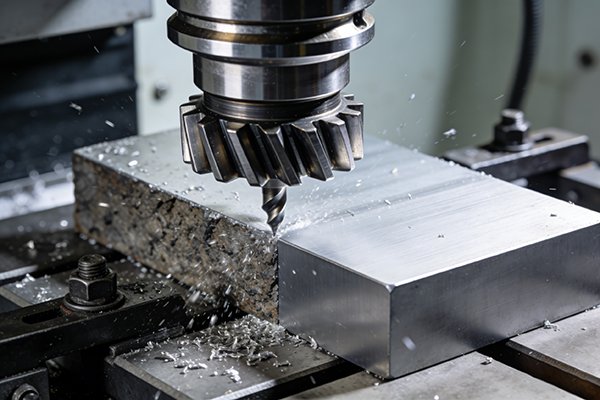
I’ve seen this problem countless times in shops all over the world. A machinist is pushing for a deadline, the machine is running, and then snap—another broken tool. It feels like you're just burning through money. But breaking tools on stainless isn't a sign of bad luck; it's a sign that the tool isn't matched to the unique challenges of the material. Let's break down exactly what's going on and how you can build a reliable process that saves you time, money, and a lot of headaches.
Why Does Stainless Steel Destroy Standard End Mills?
Ever wonder why stainless steel eats standard end mills for breakfast? Its unique properties create a perfect storm of heat, abrasion, and work hardening1. Understanding this is the first step to beating it.
Stainless steel destroys standard end mills because it generates extreme heat, work-hardens instantly during cutting, and has a "gummy" nature. This combination causes the cutting edge to soften, chip from excessive force, and fail from chips welding to the flutes (built-up edge).
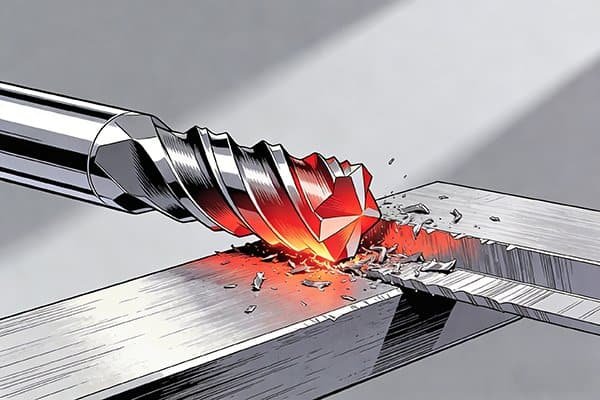
When we machine a material like aluminum, the heat generated escapes with the chip. It’s a clean, efficient process. Stainless steel is completely different. It’s a poor thermal conductor2, which means the heat doesn't want to leave. Instead, it concentrates right at the most vulnerable place: the cutting edge of your end mill. This intense heat can soften the carbide substrate, making it lose its hardness and wear out incredibly fast.
Then there's work hardening. As your end mill cuts, the shearing action hardens the layer of material just ahead of the cutting edge. You are literally making the material harder as you try to cut it. A standard tool that isn’t sharp enough or is running at the wrong speed will just rub and push against the material, making the work-hardened layer3 even worse. This puts massive pressure on the cutting edge, leading to micro-chipping and eventual fracture. Finally, the high nickel and chromium content makes stainless "gummy." The hot chips want to stick and weld themselves to your tool, an issue we call built-up edge (BUE)4. When that BUE breaks off, it often rips a piece of carbide with it, causing catastrophic tool failure.
| Challenge | Description | Consequence |
|---|---|---|
| High Heat Generation | Poor thermal conductivity traps heat at the cutting edge. | Softens the carbide, causing rapid wear and deformation. |
| Work Hardening | The material becomes harder during the cutting process. | Dramatically increases cutting forces, leading to edge chipping and breakage. |
| Chip Adhesion | "Gummy" material welds to the tool, creating a built-up edge (BUE). | Poor surface finish, increased forces, and tool fracture when BUE breaks off. |
Is Your Carbide Grade Tough Enough to Handle the Heat?
Is your carbide end mill just too brittle for the job? Using a standard grade on stainless steel is like bringing a knife to a gunfight. Let’s talk about the right material for the battle.
Your carbide grade needs exceptional toughness. We recommend a "micro-particle" or "sub-micron" carbide. This fine-grain structure provides high bending strength to resist the immense cutting forces and prevent the cutting edge from chipping or fracturing under the high heat and pressure of machining stainless steel.
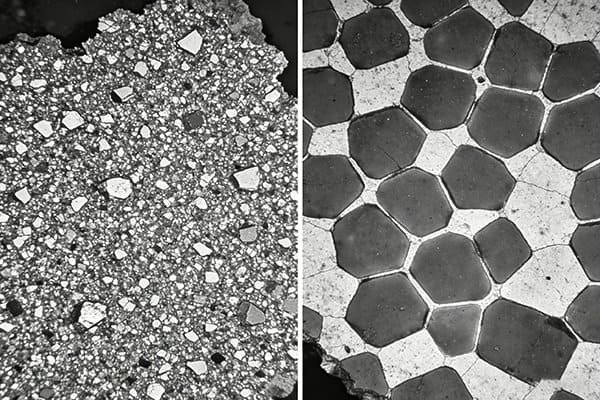
Not all carbide is created equal. When we talk about "micro-particle" or "sub-micron" grain carbide5, we're talking about the internal structure of the tool. Imagine building a wall with huge, clunky boulders versus building one with small, tightly packed bricks. The wall made of bricks is denser and stronger. It's the same with carbide. A micro-particle grade has very fine grains of tungsten carbide cemented together. This dense structure gives the tool a much higher transverse rupture strength (TRS)6, which is just a technical way of saying it has better toughness and can handle bending forces without snapping.
A standard, general-purpose carbide grade might be very hard, but it's often more brittle. In stainless steel, where cutting forces are high and inconsistent, that brittleness is a major liability. The tool can't flex under the load; it just breaks. A tough, micro-particle grade can withstand those forces. At NINEVIBES, we build our stainless-steel-specific end mills on premium micro-particle carbide substrates, often sourced from industry leaders like Walter in Germany. This foundation is non-negotiable for reliable performance in tough materials.
How Can Flute Geometry Aggressively Eject Chips and Reduce Cutting Forces?
Are clogged flutes and chattering ruining your parts? Poor chip evacuation is a silent killer for end mills in stainless steel. The right geometry can solve this problem instantly.
A high helix angle (38°-45°) aggressively pulls chips up and out of the cut, reducing cutting forces.7 A sharp cutting edge, often with a protective edge treatment, slices cleanly to minimize work hardening. This combination ensures smooth cutting and prevents chip packing.
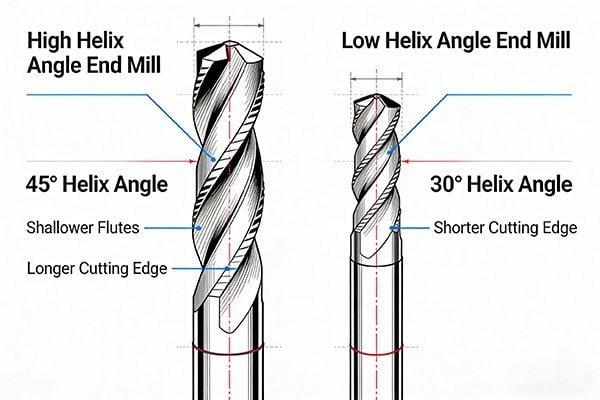
Think of the flutes on your end mill like the threads on a screw. A low helix angle (around 30°) doesn't pull chips out very aggressively. A high helix angle (like 40° or 45°) acts like a power auger, actively lifting and ejecting chips from the cutting zone. This is absolutely critical in stainless steel. If chips pack in the flute, they trap heat right against the tool, and failure is just moments away. The high helix also provides a smoother, shearing cut, which lowers cutting forces and helps reduce that nasty work-hardening effect.
But the geometry story doesn't end there. We need a perfect balance between sharpness and strength at the cutting edge. A razor-sharp edge is ideal for slicing cleanly through the gummy material. However, a razor edge is also very fragile. That’s why we often apply a very subtle edge preparation, like a tiny chamfer or a hone8. This reinforces the cutting edge just enough to resist chipping without making it dull. It’s a delicate balance, but it’s one that makes the difference between a tool that lasts for hours and one that lasts for minutes.
| Feature | Low Helix Angle (e.g., 30°) | High Helix Angle (e.g., 40°-45°) |
|---|---|---|
| Chip Evacuation | Less effective; relies more on pushing chips. | Very effective; actively pulls chips up and out. |
| Cutting Action | More of a "chopping" action. | Smoother "shearing" or "slicing" action. |
| Cutting Forces | Higher axial and radial forces. | Lower cutting forces, less tool pressure. |
| Ideal Application | General purpose, harder materials. | Stainless steels, high-temp alloys, aluminum. |
Which Coating Acts as the Best Thermal Shield for Your Cutting Edge?
Is heat burning up your end mills and your budget? An uncoated tool in stainless steel is basically a consumable fuse. The right coating is your tool’s personal heat shield.
The best coatings are AlTiN, TiAlN, or advanced AlCrN9. At high temperatures, these coatings form a hard, slick layer of aluminum oxide. This layer acts as a thermal barrier, insulating the carbide from heat and preventing sticky stainless steel chips from welding to the tool.
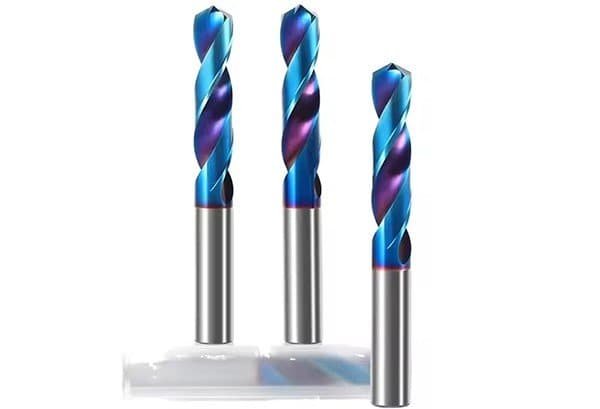
A coating on an end mill is much more than just a colored layer. It's advanced technology designed to fight heat and friction. When machining stainless steel, coatings containing aluminum, like AlTiN (Aluminum Titanium Nitride) or AlCrN (Aluminum Chromium Nitride), are my top recommendation. Here’s why: as the cutting edge heats up, the aluminum in the coating reacts with the air to form a microscopic layer of aluminum oxide10. This oxide layer is essentially a type of ceramic—it's incredibly hard and an excellent thermal insulator.
This self-forming ceramic layer does two critical jobs. First, it acts as a shield11, preventing the intense heat from soaking into the carbide substrate and softening it. Most of the heat is forced to leave with the chip, which is exactly where we want it to go. Second, it creates a super-slick surface. This lubricity prevents the gummy stainless steel chips from sticking to the cutting edge, effectively stopping built-up edge before it can even start. A standard gold-colored TiN coating simply can’t do this; it breaks down at the temperatures we see in stainless steel. Our advanced PVD coatings are specifically engineered to thrive in this high-heat environment.
Should You Prioritize Aggressive Roughing or Flawless Finishing?
Using the same tool for roughing and finishing stainless steel? That’s a common mistake that leads to broken tools and bad finishes. Choosing the right flute count makes all the difference.
For aggressive roughing, use a 4-flute end mill. Its strong core handles heavy cuts. For finishing, or when dealing with deep slots, switch to a 3-flute or even 2-flute tool. Their larger flute valleys provide superior chip evacuation.
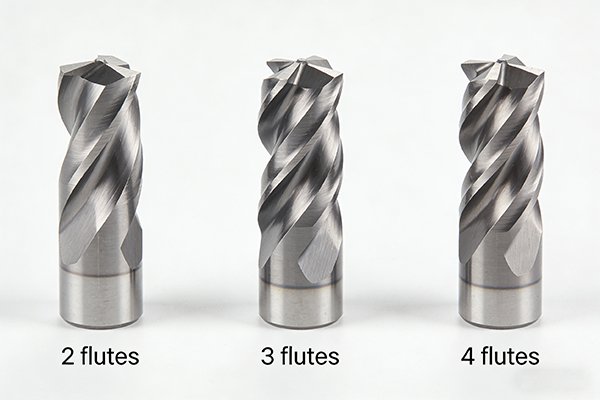
Your machining strategy must change between bulk material removal (roughing) and creating a perfect surface (finishing). For roughing, we need strength and rigidity. A 4-flute end mill is the ideal choice here. With four flutes, the tool has a thicker, stronger core that can withstand the high forces of deep, aggressive cuts. More flutes also mean you can run higher feed rates, removing material faster. The main trade-off is that the space for chips to escape is smaller, so this works best in open areas where chips can be cleared easily.
However, for finishing passes or cutting deep slots and pockets, the number one priority is chip evacuation. This is where a 3-flute or even a 2-flute end mill shines. By removing a flute, we create a massive, deep valley for chips to form and get out of the way. In a tight slot, if chips can't escape, they will pack together, generate a ton of heat, and snap the tool in an instant. Fewer flutes prevent this. For the absolute best performance, especially on deep walls, we sometimes use tools with a variable helix design, which changes the timing of each cut to cancel out chatter and vibrations, leaving a beautiful finish.
| Application | Recommended Flute Count | Why It Works |
|---|---|---|
| Aggressive Roughing | 4-Flute | Stronger core diameter for rigidity; allows for higher feed rates. |
| Slotting / Pocketing | 3-Flute or 2-Flute | Maximum space for chip evacuation, prevents packing and heat buildup. |
| Finishing | 3-Flute or 4-Flute (Variable Helix) | Fewer flutes for chip clearance, variable design to eliminate chatter. |
Conclusion
Success in machining stainless steel isn't about one magic bullet. It’s a complete system: tough micro-particle carbide, smart geometry, an advanced coating, and the right flute count for the job.
"Work-hardening in the drilling of austenitic stainless steels", https://www.sciencedirect.com/science/article/abs/pii/S0924013602002455. Machining literature describes austenitic stainless steels as prone to work hardening during cutting, which can raise cutting forces and accelerate tool wear when rubbing or inadequate cutting conditions occur. Evidence role: mechanism; source type: paper. Supports: Stainless steel can harden during cutting, increasing cutting forces and contributing to tool wear or failure.. Scope note: The source may address stainless steels broadly or austenitic grades specifically, so the support is strongest for common 300-series stainless steels. ↩
"Measurements of thermophysical properties of solid and ...", https://tsapps.nist.gov/publication/get_pdf.cfm?pub_id=928362. Reference data for common stainless steels report thermal conductivity substantially lower than that of aluminum and many carbon steels, supporting the characterization of stainless steel as a relatively poor heat conductor in machining contexts. Evidence role: general_support; source type: government. Supports: Stainless steel is a poor thermal conductor compared with materials such as aluminum, causing more heat to remain near the cutting zone.. Scope note: Material-property data support the thermal-conductivity comparison but do not by themselves quantify heat concentration for this specific end-milling setup. ↩
"Tool wear and surface integrity analysis of austenitic stainless-steel ...", https://www.sciencedirect.com/science/article/abs/pii/S0263436825001829. Research on machining austenitic stainless steel reports that cutting conditions and tool geometry influence surface work hardening, supporting the claim that clean shearing rather than rubbing helps limit hardened surface layers. Evidence role: mechanism; source type: paper. Supports: Cutting action and tool condition can influence work hardening of machined stainless-steel surfaces.. Scope note: The evidence may not isolate edge sharpness alone; surface work hardening is affected by speed, feed, depth of cut, coolant, and tool wear. ↩
"Built-up edge", https://en.wikipedia.org/wiki/Built-up_edge. Machining references define built-up edge as adhered workpiece material on the cutting edge and note that it can degrade surface finish and promote tool wear or edge damage, supporting the mechanism described here. Evidence role: definition; source type: education. Supports: Built-up edge occurs when workpiece material adheres to the cutting edge and can damage the tool when it breaks away.. Scope note: General BUE references may not be limited to stainless steel end milling, so the support is partly contextual. ↩
"Wear Characteristics of WC-Co Cutting Tools Obtained by the ...", https://pmc.ncbi.nlm.nih.gov/articles/PMC12387649/. Studies of cemented carbides associate finer tungsten-carbide grain sizes with improved strength and wear-related properties, supporting the use of submicron carbide grades where cutting-edge toughness is required. Evidence role: mechanism; source type: paper. Supports: Submicron cemented-carbide grain structures can improve mechanical strength and toughness-related performance in cutting tools.. Scope note: Performance depends also on cobalt content, binder chemistry, coating, and tool geometry, so grain size alone is not a complete predictor of end-mill life. ↩
"Effect of size and location of spherical pores on transverse ...", https://www.sciencedirect.com/science/article/abs/pii/S0921509307016516. Materials references for cemented carbides use transverse rupture strength as a measure of resistance to bending fracture, and published data show TRS varies with carbide grade and microstructure. Evidence role: definition; source type: research. Supports: Transverse rupture strength is relevant to a carbide tool’s ability to resist bending-related fracture.. Scope note: TRS is a standardized material-property indicator, but actual end-mill breakage also depends on tool design, cutting parameters, and machine rigidity. ↩
"Helical - MACHINING GUIDEBOOK", https://web.mae.ufl.edu/designlab/Advanced%20Manufacturing/Helical_Machining_Guidebook.pdf. Milling-tool geometry literature explains that helix angle affects chip flow and the direction and magnitude of cutting forces, providing contextual support for the claim that higher helix tools can improve chip evacuation and reduce force components. Evidence role: mechanism; source type: paper. Supports: Higher helix angles can improve chip flow and influence cutting forces in milling.. Scope note: The cited literature may support the effect of helix angle generally; the exact 38°–45° range and performance outcome depend on tool diameter, flute count, material grade, and cutting conditions. ↩
"Preparation of asymmetrical cutting edge geometries on ...", https://www.sciencedirect.com/science/article/abs/pii/S1755581724000646. Cutting-tool studies report that edge preparation such as honing or chamfering can strengthen the cutting edge and influence chipping, wear, and cutting forces, supporting the stated tradeoff between sharpness and edge robustness. Evidence role: mechanism; source type: paper. Supports: Small chamfers or hones can improve cutting-edge robustness and reduce chipping risk.. Scope note: Optimal edge preparation is application-specific; excessive honing can increase forces or worsen performance in some operations. ↩
"Study of PVD AlCrN Coating for Reducing Carbide Cutting Tool ...", https://pmc.ncbi.nlm.nih.gov/articles/PMC5458959/. Coating literature describes AlTiN/TiAlN and AlCrN hard coatings as high-temperature PVD coatings used on cutting tools, with oxidation resistance and hot hardness relevant to machining applications. Evidence role: expert_consensus; source type: paper. Supports: AlTiN/TiAlN and AlCrN are high-temperature cutting-tool coatings suitable for demanding machining conditions.. Scope note: The source can support suitability in high-temperature cutting generally, but it may not rank one coating as universally best for every stainless-steel operation. ↩
"Surface and Coatings Technology", https://arxiv.org/pdf/1810.05029. Oxidation studies of aluminum-containing nitride coatings report formation of protective alumina-rich oxide scales at elevated temperatures, supporting the mechanism by which AlTiN/TiAlN or AlCrN coatings resist heat and oxidation. Evidence role: mechanism; source type: paper. Supports: Aluminum-containing nitride tool coatings can form protective aluminum-oxide layers at high temperatures.. Scope note: The exact oxide composition and temperature threshold vary with coating chemistry, architecture, and test atmosphere. ↩
"Coating-thickness-dependent physical properties and cutting ...", https://pmc.ncbi.nlm.nih.gov/articles/PMC9091928/. Research on hard nitride coatings identifies oxide-scale formation and low thermal conductivity as factors that can reduce heat transfer to the cutting-tool substrate, supporting the description of these coatings as thermal barriers. Evidence role: mechanism; source type: paper. Supports: Aluminum-containing hard coatings can help insulate the carbide substrate from cutting heat.. Scope note: The evidence supports the thermal-barrier mechanism generally; actual tool temperature reduction depends on cutting speed, coolant use, coating thickness, and chip formation. ↩