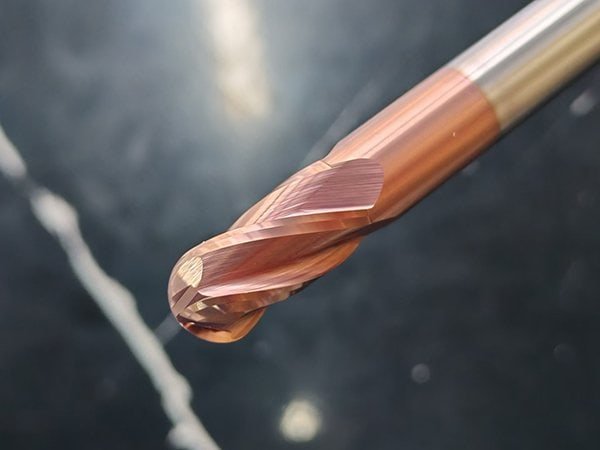
Struggling with weak corners or poor surface finishes on your parts? These issues can lead to part failure and costly rework, slowing down your entire production line.
A bull nose end mill is the right choice for profiling, pocketing, and contouring where corner strength and a superior surface finish are critical. It is not the right choice when your design requires a sharp, 90-degree internal corner, as it will always leave a radius.
Choosing the right cutting tool is one of the most important decisions you'll make in any machining job. It directly impacts part quality, tool life, and how much money you spend.1 The bull nose end mill is a fantastic tool, but only if you use it in the right situation. Let's break down exactly when you should reach for it, and when you should leave it in the drawer.
Why Does It Trade a Sharp Corner for Superior Strength?
A standard square end mill often leaves a sharp internal corner. This sharp corner becomes a weak point where cracks can easily start under stress2, leading to premature part failure.
The bull nose end mill's rounded corner distributes cutting forces and stress more evenly across the cutting edge3. This eliminates the sharp stress concentration point found in square end mills4, which dramatically increases the tool's strength and prevents the edge from chipping5.
To understand this better, let's dive into the physics of cutting. When a tool cuts metal, a massive amount of force is concentrated on a very small area—the cutting edge6. With a square end mill, all that force hammers down on a tiny, sharp 90-degree point. This point is fragile and prone to chipping or breaking7, especially in tough materials or during aggressive roughing operations. It also creates a sharp internal corner on the workpiece, which is a classic stress riser. Think about tearing a piece of paper; it's much easier to start the tear from a sharp corner than from a smooth, rounded edge. The bull nose end mill solves both problems. The small radius on its corner gives the cutting edge a much stronger geometry. It spreads the cutting force out over a larger area, which is why it can handle higher feed rates and lasts so much longer.
Strength Comparison: Square vs. Bull Nose
| Feature | Square End Mill | Bull Nose End Mill |
|---|---|---|
| Corner Geometry | Sharp 90-degree angle | Rounded corner radius |
| Stress Point | Highly concentrated | Distributed over the radius |
| Chipping Risk | High | Low |
| Ideal Use | Creating sharp corners | General purpose, high-strength |
How Can It Save You Money and Improve Part Quality?
Achieving a great surface finish often requires extra finishing passes. This means more machine time, more tool changes, and ultimately, higher costs for you or your customer.
It improves part quality by creating a much smoother surface finish, reducing the scallops left between passes8. It saves you money by extending tool life due to its stronger corner and by allowing for higher feed rates, which significantly shortens cycle times.
The financial and quality benefits of using a bull nose end mill are very real. The key is in the shape of the cutting edge. When you are surface milling, the rounded corner helps to smooth out the "cusps" or "scallops" left behind on the material surface. This results in a better finish straight off the machine9, which can eliminate the need for secondary polishing or finishing operations. That saves a huge amount of time. Then there's the tool life. Because the corner is so much stronger, the tool simply lasts longer. I've seen customers double or even triple their tool life just by switching from a square end mill to a bull nose for roughing and semi-finishing jobs. This means you buy fewer tools. Finally, that added strength allows you to run the machine faster and harder. Higher feed rates mean the job gets done quicker, reducing the cost per part.10
The Double Win: Cost and Quality
| Feature | Impact on Quality | Impact on Cost |
|---|---|---|
| Corner Radius | Smoother surface finish, fewer scallops | Eliminates secondary finishing passes |
| Stronger Edge | More durable part with stronger corners | Longer tool life, fewer tool purchases |
| Higher Feed Rates | Consistent finish at higher speeds | Reduced cycle time, lower machine hour cost |
What Are Its Real-World Limitations?
You have a job that absolutely requires a perfect 90-degree internal corner. Using the wrong tool here will ruin the part, waste expensive material, and force you to start over.
Its biggest limitation is its inability to create a sharp, 90-degree internal corner. The tool's design means it will always leave a radius in the corner of a pocket or against a vertical wall11, making it unsuitable for parts requiring perfectly square features.
While the bull nose end mill is incredibly versatile, it's not a magic bullet for every situation. Its defining feature—the corner radius—is also its primary limitation. If you are machining a pocket where another square part needs to fit perfectly, you cannot have a radius in the corner. It just won't work. This is common in mold and die making or when machining components that need to mate precisely. In these cases, you have no choice but to use a square end mill to get that sharp corner. Another thing to consider is your CAM programming. You must tell your software that you are using a tool with a specific corner radius. If you forget, your toolpaths will be incorrect, and the final part will not match the design dimensions. This is a simple step, but an easy one to forget. So, the rule is simple: if the print calls for a sharp corner, don't use a bull nose end mill.
When to Use a Different Tool
- For Sharp 90° Corners: Use a standard Square End Mill. We stock thousands of them for this exact purpose.
- For Finishing Flat Floors: A dedicated Face Mill might provide an even better, flatter surface.
- For Complex 3D Surfaces: A Ball Nose End Mill is the tool designed for smooth, complex contouring.
So, What's the Final Verdict?
Choosing the right end mill from a catalog can feel overwhelming. Making the wrong choice costs you real time and money on the shop floor, and nobody can afford that.
The final verdict is clear: Use a bull nose end mill for its superior strength, excellent surface finish, and longer tool life in most profiling and pocketing jobs. Avoid it only when your part design explicitly requires sharp, 90-degree internal corners.
After years of supplying tools to shops around the world, my advice is to make the bull nose end mill your go-to tool for general-purpose milling. It is more robust, more forgiving, and more efficient than a standard square end mill for the majority of applications. It will save you money in the long run through increased tool life and faster cycle times. The only time you should hesitate is when you look at the part drawing and see a requirement for a perfectly square inside corner. For everything else, the strength and finish provided by the corner radius give you a significant advantage. It's about working smarter, not harder, and choosing the tool that gives you the best balance of performance and economy.
A Simple Checklist for Your Next Job
- Use a Bull Nose End Mill if:
- Your part requires strong internal corners to prevent cracking.
- A high-quality surface finish is important.
- You want to maximize tool life and run at higher feed rates.
- The design allows for a small radius in the corners.
- Use a Square End Mill if:
- You absolutely must machine a perfect 90-degree internal corner.
- The part design has zero tolerance for any corner radius.
Conclusion
The bull nose end mill is a powerful tool for strength and finish. Knowing its main limitation—the inability to cut sharp corners—is the key to using it effectively.
"Cutting Tool Materials 321 - Purdue University", https://www.purdue.edu/whin/education/courses/course-page.php?ID=260220. Authoritative machining references describe cutting-tool selection and geometry as factors affecting surface integrity, tool wear or life, and machining economics. Evidence role: general_support; source type: education. Supports: Choosing the right cutting tool directly impacts part quality, tool life, and machining cost.. Scope note: This supports the general relationship between tool choice and outcomes, but not a quantified cost effect for any specific shop or operation. ↩
"[PDF] 6. stress concentration and stress raisers", https://courses.washington.edu/me354a/chap6.pdf. Fracture-mechanics and engineering-design sources describe sharp notches and internal corners as stress concentrators that can promote crack initiation under load. Evidence role: mechanism; source type: education. Supports: A sharp internal corner can act as a weak point where cracks initiate under stress.. Scope note: The source may address stress concentration in mechanical parts generally rather than specifically machined pockets made by square end mills. ↩
"Research on Cutting Force Modeling and Machining ... - PMC", https://pmc.ncbi.nlm.nih.gov/articles/PMC12388261/. Machining-mechanics literature on tool edge radius and corner geometry explains that increasing the engaged edge radius can distribute contact and cutting loads over a larger edge region. Evidence role: mechanism; source type: paper. Supports: A bull nose end mill’s rounded corner distributes cutting forces and stress more evenly across the cutting edge.. Scope note: Evidence may describe the mechanical principle of radiused cutting edges rather than testing the exact bull nose end mill named in the article. ↩
"Variable Radius Fillet Shape Analysis to Minimize Stress ...", https://scholars.csus.edu/esploro/outputs/conferencePaper/Variable-Radius-Fillet-Shape-Analysis-to/99258116063901671. Engineering-design references on fillets and notches show that replacing a sharp corner with a radius lowers local stress concentration relative to an unfilleted corner. Evidence role: mechanism; source type: education. Supports: A rounded corner removes or reduces the sharp stress-concentration point associated with square internal corners.. Scope note: This supports the stress-concentration principle; it does not prove that every bull nose operation fully eliminates stress concentration in all tool and workpiece conditions. ↩
"Influence of cutting edge geometry and cutting edge radius ...", https://www.academia.edu/15461112/Influence_of_cutting_edge_geometry_and_cutting_edge_radius_on_the_stability_of_micromilling_processes. Studies of end-mill corner radius and tool wear report that corner geometry influences edge strength, chipping, and wear behavior during milling. Evidence role: general_support; source type: paper. Supports: A corner radius can increase end-mill edge strength and reduce chipping compared with a sharp corner.. Scope note: The word “dramatically” is stronger than most sources will support unless a specific comparative study and operating condition are cited. ↩
"A predictive model for the cutting force in wood machining ...", https://bioresources.cnr.ncsu.edu/resources/a-predictive-model-for-the-cutting-force-in-wood-machining-developed-using-mechanical-properties/. Machining-mechanics sources describe metal cutting as a localized deformation process in which cutting forces act through a small contact region near the cutting edge and shear zone. Evidence role: mechanism; source type: education. Supports: Metal cutting concentrates force in a small region near the cutting edge.. Scope note: The source will likely describe general metal-cutting mechanics rather than the exact magnitude of force in the article’s unspecified operation. ↩
"Modeling cutting edge degradation by chipping in micro- ...", https://www.sciencedirect.com/science/article/abs/pii/S004316482100524X. Machining research on tool failure modes identifies edge chipping and fracture as common failures influenced by cutting-edge geometry, loading, and work material. Evidence role: general_support; source type: paper. Supports: The sharp 90-degree corner of a square end mill can be prone to chipping or breaking under demanding cutting conditions.. Scope note: The source may not establish that all square end mills are inherently fragile; the effect depends on tool material, coating, cutting parameters, and workpiece material. ↩
"(PDF) Cutting Tool Path Modi cation to Uniform Scallop-Height in ...", https://www.academia.edu/90797237/Cutting_Tool_Path_Modi_cation_to_Uniform_Scallop_Height_in_Three_Axis_Milling_Operations. Machining and CAM references explain that tool geometry, stepover, and tool radius determine cusp or scallop height left between adjacent toolpaths. Evidence role: mechanism; source type: education. Supports: A rounded tool corner can reduce scallops left between passes during surface milling.. Scope note: The source supports the geometric relationship; actual surface finish also depends on vibration, tool wear, material, runout, and cutting parameters. ↩
"Investigation of the Effect of End Mill-Geometry on Roughness ...", https://pmc.ncbi.nlm.nih.gov/articles/PMC7411701/. Surface-milling studies and manufacturing references associate smaller cusp height and appropriate tool radius with improved as-machined surface roughness. Evidence role: general_support; source type: paper. Supports: A bull nose end mill can produce a better as-machined surface finish in suitable milling operations.. Scope note: This supports a likely improvement in as-machined finish, but it does not guarantee elimination of polishing or finishing operations for all tolerances or materials. ↩
"[PDF] A NEW MACHINING COST CALCULATOR (MC2)", https://mtrc.utk.edu/wp-content/uploads/sites/45/2019/09/johnson_schmitz_ASPE_2011.pdf. Machining-economics sources explain that increasing feed rate can reduce machining time, and that machining time is a component of unit manufacturing cost. Evidence role: mechanism; source type: education. Supports: Higher feed rates can shorten cycle time and reduce cost per part.. Scope note: The cost reduction applies only if higher feed rates do not increase scrap, tool wear, downtime, or other costs enough to offset the time saving. ↩
"Week 5: CNC Machining: "Make Something Big" - MIT Fab Lab", http://fab.cba.mit.edu/classes/863.13/people/alice/week5.html. CNC machining and end-mill geometry references state that a tool with a corner radius cannot generate a perfectly sharp internal corner and will leave a corresponding radius in internal features. Evidence role: definition; source type: education. Supports: A bull nose end mill cannot cut a sharp 90-degree internal corner and leaves a radius.. Scope note: The exact remaining radius depends on tool geometry, toolpath strategy, and any subsequent operations such as EDM or broaching. ↩