Choosing the wrong milling cutter wastes time, money, and materials. It's frustrating when a tool breaks or ruins a workpiece. This guide matches the right tool to your specific job.
The right milling cutter depends entirely on the feature you are machining. Use large face mills for flat surfaces, flat-end mills for square pockets and profiles, and ball-end mills for 3D contours. Specialized tools like thread mills and T-slot cutters handle more complex features.
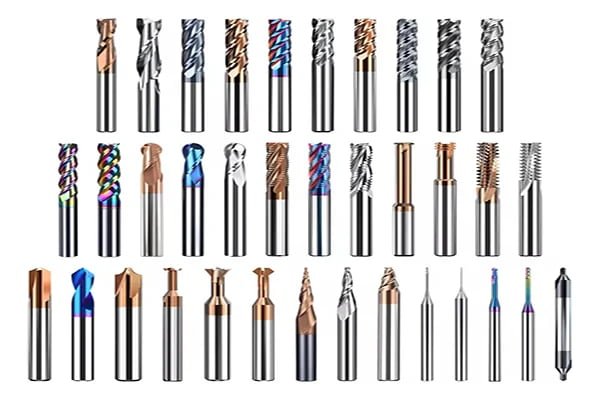
Over the years I've been running NV-Tool, I've seen countless machine shops struggle with this exact problem. A customer in Brazil once told me they were burning through tools trying to machine a simple pocket because they were using the wrong geometry. Getting the tool selection right from the start is more than half the battle. It saves you headaches, broken tools, and scrapped parts. Let's break this down job by job, so you can pick the perfect tool every time.
How Do I Machine Large, Flat Surfaces and Faces?
Need a perfect, flat finish on a large workpiece? Using an end mill that's too small takes forever and can leave ugly tool marks. You need the right tool for fast, clean results.
For large, flat surfaces, a face mill with indexable inserts1 is your best choice. It removes a lot of material quickly and leaves a superior finish. For smaller flat areas, a large-diameter solid carbide flat-end mill is also a great option.
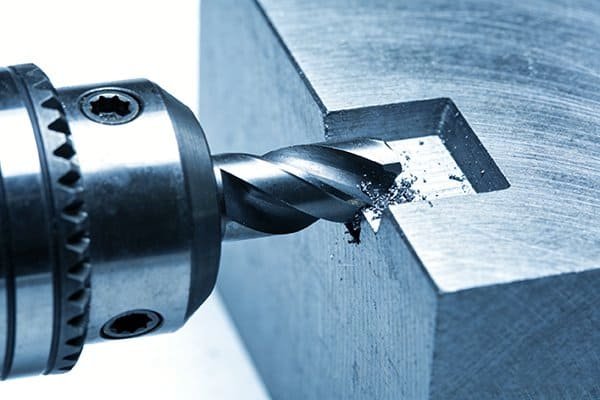
When your goal is to create a flat, smooth surface, what we call "facing," your primary concern is covering a large area efficiently. This is where a face mill truly shines. A face mill is a large-diameter cutter that holds multiple replaceable carbide inserts around its body. This design allows for a very wide cut, drastically reducing the number of passes needed2 to flatten a surface compared to a standard end mill. I remember a client in the automotive sector who cut their cycle time for facing engine blocks by nearly 40% just by switching to one of our indexable face mills. The inserts can be quickly replaced when they wear out, which is much more cost-effective than replacing an entire solid tool3.
Face Mill vs. Solid End Mill
| Feature | Face Mill with Inserts | Solid Carbide End Mill |
|---|---|---|
| Best For | Large, open surfaces | Smaller faces, pocket floors |
| Speed | Very high material removal rate | Slower, limited by diameter |
| Cost | Higher initial tool body cost, cheap inserts | Lower initial tool cost, replace whole tool |
| Finish | Excellent, consistent finish | Good, but can show pass lines |
What Are the Go-To Tools for Cutting Profiles, Pockets, and 3D Contours?
Machining complex shapes can be tricky. Using the wrong tool geometry leads to poor accuracy, bad surface finish, and corners that aren't quite right. The right end mill makes it simple and precise.
Use a flat-bottom end mill4 for 2D profiles and pockets with sharp, 90-degree corners. For sloped walls and 3D surfacing, a ball-end mill is essential. A round nose (or bull nose) end mill offers a balance, strengthening the corner for heavy cutting.
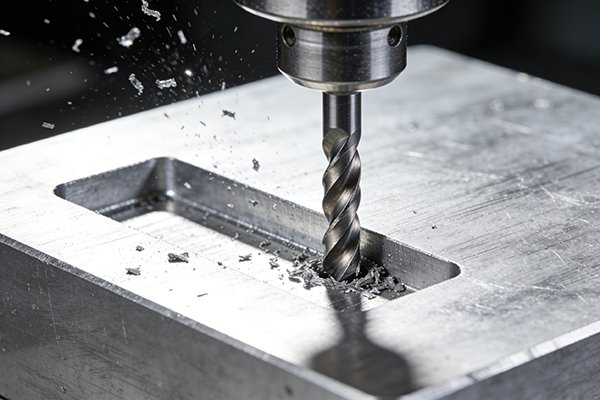
This is where the shape of the tool's tip becomes critical. The geometry of your end mill must match the geometry of the feature you want to create. For standard 2D work like cutting a square pocket or tracing the outside profile of a part, a simple flat-bottom end mill is the workhorse. It gives you those crisp, 90-degree internal corners and flat floors. But when you move into 3D machining, like for molds or aerospace components, you need a different approach. A ball-end mill5, with its perfectly round tip, can move smoothly along complex, curved surfaces without gouging the material. A round nose end mill is a fantastic compromise; it has a flat bottom but with rounded corners. This small radius adds a lot of strength to the cutting edge6, making it great for roughing out pockets without the risk of chipping the corners.
End Mill Profiles for Different Jobs
| Tool Type | Primary Use | Key Advantage |
|---|---|---|
| Flat-Bottom End Mill | Pockets, profiling, facing | Creates true 90° corners and flat floors. |
| Ball-End Mill | 3D contouring, surfacing, filleting | Smoothly machines complex curves and organic shapes. |
| Round Nose (Bull) Mill | Roughing, pocketing, chamfering | Corner radius adds strength and reduces tool chipping. |
Which Tools Are Specifically Designed for Making Slots and Grooves?
Cutting a clean, accurate slot is tough. Chips get packed in the tight space, heat builds up, and tools can easily break. You need a tool designed for strength and excellent chip evacuation.
For slots and grooves, a 2-flute or 3-flute end mill is ideal because it provides maximum chip clearance. For specialized grooves, you might need a T-slot cutter or a dovetail cutter for angled slots. The number of flutes is the most critical factor.
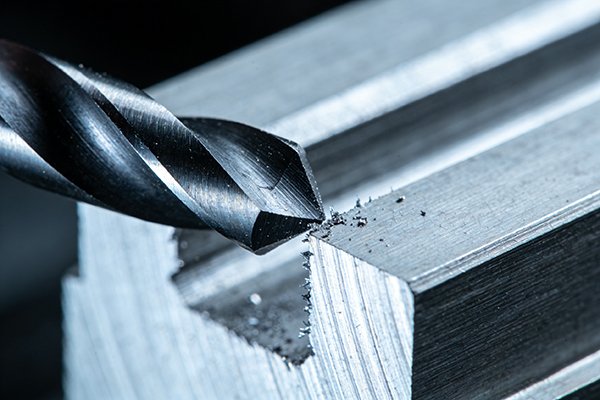
When you're milling a slot, the tool is engaged with the material on three sides7. This creates a lot of heat and makes it very difficult for chips to escape. If chips get packed in the flutes, the tool will almost certainly break. That's why we almost always recommend end mills with fewer flutes for slotting8. A 2-flute end mill has huge, deep flutes that can easily carry chips up and out of the slot. This is especially important in materials like aluminum that produce long, stringy chips. A 4-flute end mill, by contrast, has a stronger core but very little room for chips, making it a poor choice for deep slotting. I've helped many customers in Mexico's manufacturing hubs solve their tool breakage issues simply by having them switch from a 4-flute to a 2 or 3-flute tool for their slotting operations.
Choosing Flute Count for Slotting
| Flute Count | Chip Evacuation | Core Strength | Best For |
|---|---|---|---|
| 2-Flute | Excellent | Lower | Slotting in aluminum, plastics, and non-ferrous metals. |
| 3-Flute | Good | Medium | A great all-around choice for slotting in steels. |
| 4+ Flutes | Poor | High | Not recommended for deep slotting; best for side milling. |
How Do I Create Complex Features like Threads or Dovetails?
Tapping threads or cutting angled grooves can be high-risk. A broken tap is a machinist's nightmare, and custom dovetails require precision. There are safer, more versatile tools for these jobs.
For internal or external threads, use a thread milling cutter. This offers more control, better thread quality, and less risk than tapping9. For angled undercuts, use a dovetail cutter. For breaking sharp edges, a chamfer mill is the perfect tool.
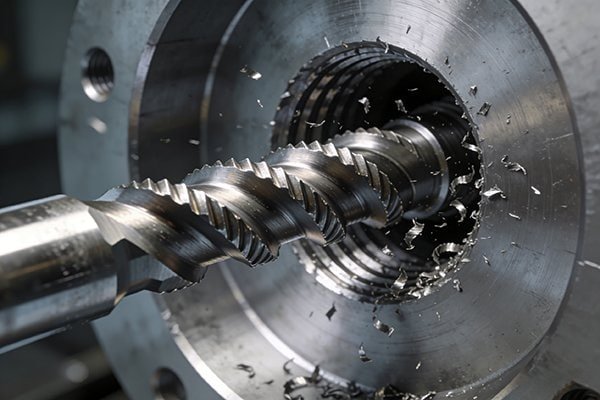
While taps are common for creating threads, they have major limitations. A tap can only create one specific thread size and pitch, and if it breaks inside the hole, you have a very expensive problem. A thread mill10 is a much more advanced and flexible solution. It's a rotary tool that moves in a helical path to cut the threads. One thread mill can create a wide range of diameters (as long as the pitch is the same), works for both internal and external threads, and gives you full control over the thread quality. If it breaks, it's a simple tool change, not a rescue mission. Similarly, for features like O-ring grooves or angled undercuts, specialized tools like dovetail or T-slot cutters11 are designed specifically for that geometry, ensuring you get an accurate and clean feature in a single, reliable step.
Specialized Tools vs. Traditional Methods
| Task | Specialized Tool | Traditional Method | Key Advantage of Specialized Tool |
|---|---|---|---|
| Threading | Thread Mill | Tap | More versatile, less risk of breakage, better quality. |
| Angled Undercut | Dovetail Cutter | Complex 5-axis moves | Simpler programming, more accurate angle. |
| Edge Breaking | Chamfer Mill | Tipping a standard end mill | Creates a consistent, clean chamfer every time. |
How Do I Select the Right Tool Based on My Material and Goal (Roughing vs. Finishing)?
Your tool works great on steel but fails instantly on aluminum. The right geometry, flute count, and coating are crucial for tool life, especially when switching between roughing, finishing, and different materials.
For roughing, use tools with fewer flutes (2-3) and a strong core. For finishing, use a multi-flute (4 or more) end mill for a better surface. Match the coating to the material: TiAlN for steels, and uncoated or DLC-coated for aluminum and composites.
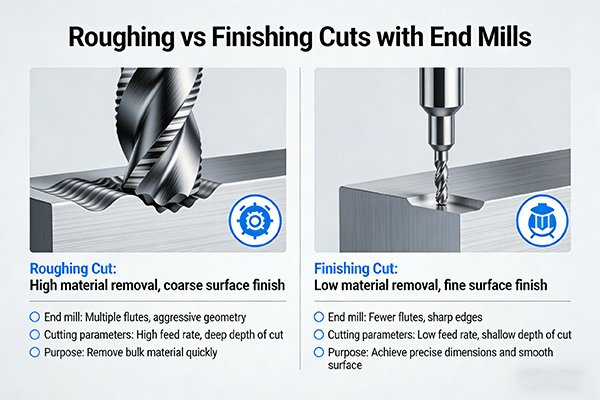
Tool selection isn't just about the shape of the part; it's also about your strategy and the material you're cutting. Roughing is all about removing as much material as possible, as quickly as possible. Here, you want a strong tool that can take a heavy cut, so a 3 or 4-flute end mill with a tough coating like TiAlN is a great choice for steels. Finishing, on the other hand, is about surface quality. For that, you want more cutting edges engaged with the material, so an end mill with 5, 6, or more flutes will give you a much smoother finish12. The material itself is a huge factor. Aluminum is soft and sticky, so you need a tool with very sharp edges and a slick surface (like an uncoated or DLC-coated tool) to prevent material from welding to the tool. Hardened steel requires a tool with a very heat-resistant coating like AlCrN.
Quick Selection Guide: Material and Goal
| Material | Goal | Recommended Flutes | Recommended Coating |
|---|---|---|---|
| Aluminum | Roughing & Finishing | 2 or 3 | Uncoated, DLC, or ZrN |
| Mild Steel | Roughing | 3 or 4 | TiAlN |
| Mild Steel | Finishing | 4 or more | TiAlN or AlCrN |
| Stainless Steel | Roughing & Finishing | 4 or 5 | AlCrN or TiAlN |
| Hardened Steel | Roughing & Finishing | 4 or more | TiAlN or AlCrN |
Conclusion
Choosing the right milling cutter is simple when you match it to the feature. By considering the job, material, and your goal, you'll get efficient, accurate results every time.
"[PDF] Milling - Advanced Materials Manufacturing", https://mie.njit.edu/sites/mie/files/me215-24-fall2017.pdf. A manufacturing engineering reference should identify face milling as the standard operation for producing flat surfaces and note that face mills commonly use multiple cutting edges or replaceable inserts for high material-removal capacity. Evidence role: definition; source type: education. Supports: For large, flat surfaces, a face mill with indexable inserts is the preferred tool because it removes material efficiently and can leave a good finish.. Scope note: This supports the general tool-selection principle, not the claim that it is always the best choice for every machine, material, or tolerance requirement. ↩
"[PDF] Milling - Advanced Materials Manufacturing", https://mie.njit.edu/sites/mie/files/me215-24-fall2017.pdf. A machining or manufacturing-process source should explain that cutter diameter and effective cutting width influence the number of passes required in face milling, providing contextual support for the efficiency advantage of larger face mills. Evidence role: mechanism; source type: education. Supports: A large-diameter face mill can reduce the number of passes needed to flatten a large surface compared with a smaller end mill.. Scope note: The word “drastically” is application-dependent and would require specific cutter diameters, workpiece dimensions, and cutting parameters to quantify. ↩
"Forstner Bit Unleashed: The Secret Hack Engineers Swear By - Rice ...", https://dev-dining.rice.edu/info/forstner-bit-unleashed-the-secret-hack-engineers-swear-by-3542452. A machining economics or tooling reference should describe indexable tooling as using replaceable cutting inserts, which can lower replacement cost relative to discarding a whole solid cutter when only the cutting edge is worn. Evidence role: mechanism; source type: education. Supports: Replacing worn inserts in an indexable face mill can be more economical than replacing a whole solid cutter.. Scope note: Actual cost-effectiveness depends on insert price, tool body cost, tool life, setup time, and production volume. ↩
"[PDF] ETHZ COMPUTER MANUFACTURING MANUAL", https://soa.princeton.edu/sites/g/files/toruqf6531/files/SoA%20CNC%20Manual.pdf. A manufacturing text or cutter-geometry reference should define flat-end mills as tools used for slotting, pocketing, and profiling where flat bottoms and square shoulders are required. Evidence role: definition; source type: education. Supports: Flat-bottom end mills are appropriate for 2D profiles and pockets requiring flat floors and square shoulders.. Scope note: The achievable sharpness of internal corners is limited by cutter radius, tool deflection, and machine accuracy. ↩
"[PDF] Helical - MACHINING GUIDEBOOK", https://web.mae.ufl.edu/designlab/Advanced%20Manufacturing/Helical_Machining_Guidebook.pdf. A machining reference should describe ball-end mills as cutters with hemispherical ends used for die, mold, and three-dimensional contour milling because their geometry follows curved surfaces smoothly. Evidence role: definition; source type: education. Supports: Ball-end mills are used for 3D contouring and surfacing of curved geometries.. Scope note: This supports the common application of ball-end mills; surface quality still depends on step-over, toolpath strategy, tool deflection, and material. ↩
"[PDF] The Effects of Corner Radius and Edge Radius on Tool Flank Wear", https://www.me.mtu.edu/~wjendres/Papers/Endres%20%26%20Kountanya%20%28JMP%202002%29.pdf. A cutter-design or machining mechanics source should explain that adding a corner radius to an end mill reduces sharp-corner stress concentration and improves edge strength compared with a sharp-corner square end mill. Evidence role: mechanism; source type: paper. Supports: A bull-nose or corner-radius end mill has a stronger cutting edge than a sharp-corner flat end mill.. Scope note: The amount of strength improvement depends on radius size, tool material, cutting parameters, and workpiece material. ↩
"[PDF] Helical - MACHINING GUIDEBOOK", https://web.mae.ufl.edu/designlab/Advanced%20Manufacturing/Helical_Machining_Guidebook.pdf. A machining-process reference should describe slot milling as a full-width cutting operation in which both sides and the bottom of the cutter are engaged, creating constrained chip evacuation compared with peripheral side milling. Evidence role: mechanism; source type: education. Supports: Slot milling produces high cutter engagement and challenging chip evacuation because the cutter is confined by the slot.. Scope note: The exact engagement and heat generation vary with radial width of cut, axial depth, coolant, and toolpath strategy. ↩
"[PDF] Helical - MACHINING GUIDEBOOK", https://web.mae.ufl.edu/designlab/Advanced%20Manufacturing/Helical_Machining_Guidebook.pdf. A tooling or manufacturing reference should explain that fewer flutes provide larger flute gullets and therefore more chip space, which is advantageous in slotting operations where chip evacuation is constrained. Evidence role: mechanism; source type: education. Supports: Two- or three-flute end mills are commonly recommended for slotting because they provide more chip clearance than higher-flute tools.. Scope note: The optimal flute count also depends on material, cutter diameter, machine rigidity, coolant, and feed per tooth. ↩
"Tool breakage detection in CNC high-speed milling based in feed ...", https://www.academia.edu/10164060/Tool_breakage_detection_in_CNC_high_speed_milling_based_in_feed_motor_current_signals. A machining source should explain that, unlike taps, thread mills are generally smaller than the thread hole and produce threads by interpolation, so tool breakage is less likely to leave a fully jammed tap in the workpiece. Evidence role: mechanism; source type: education. Supports: Thread milling can reduce the consequences or likelihood of tool-breakage problems compared with tapping.. Scope note: This supports a common risk comparison, but actual breakage risk depends on tool size, material, hole depth, programming, and machine condition. ↩
"(DOC) Dhariwal Woollen Textile Mills - Academia.edu", https://www.academia.edu/9423544/Dhariwal_Woollen_Textile_Mills. A machining reference should state that thread milling uses helical interpolation to generate internal or external threads and can produce different thread diameters of the same pitch with one cutter, unlike a tap of fixed size. Evidence role: definition; source type: education. Supports: Thread mills provide greater diameter flexibility than taps and can be used for both internal and external threads.. Scope note: Thread milling requires CNC interpolation capability and is not automatically superior for every thread size, material, or production volume. ↩
"[PDF] MILLING OPERATIONS TYPES OF MILLING MACHINES", https://uhv.cheme.cmu.edu/procedures/machining/ch8.pdf. A manufacturing or machining reference should define T-slot cutters and dovetail cutters as form tools designed to machine undercut slots with T-shaped or angled dovetail profiles. Evidence role: definition; source type: education. Supports: Dovetail and T-slot cutters are specialized milling cutters for angled undercuts and T-shaped grooves.. Scope note: This supports the intended geometry of the tools, not the claim that they always produce the feature in one pass or with superior accuracy in all materials. ↩
"Effect of sharpness angle and feeding speed on the surface ...", https://bioresources.cnr.ncsu.edu/resources/effect-of-sharpness-angle-and-feeding-speed-on-the-surface-roughness-during-milling-of-various-wood-species/. A machining reference should explain that increasing the number of cutting edges can reduce feed per tooth for a given feed rate and improve surface finish in finishing operations, provided chip evacuation and cutting conditions are suitable. Evidence role: mechanism; source type: education. Supports: Higher-flute-count end mills are commonly used for finishing because more cutting edges can improve surface finish under appropriate conditions.. Scope note: More flutes do not guarantee a smoother finish if chatter, tool runout, poor chip evacuation, or incorrect feeds and speeds dominate the process. ↩