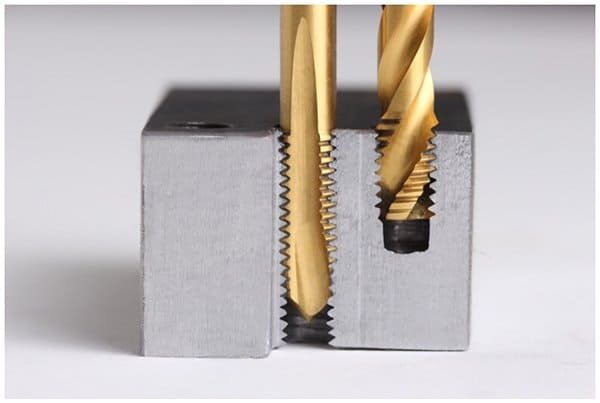
Struggling with broken taps and poor threads? Choosing the wrong tool wastes time and money. It’s a frustrating problem that stops your production line dead in its tracks.
To choose the right thread tap, first determine if your hole is through or blind. Next, check if your material is suitable for cutting or forming. Finally, match the tap's geometry and coating to the material for the best performance and longest tool life.
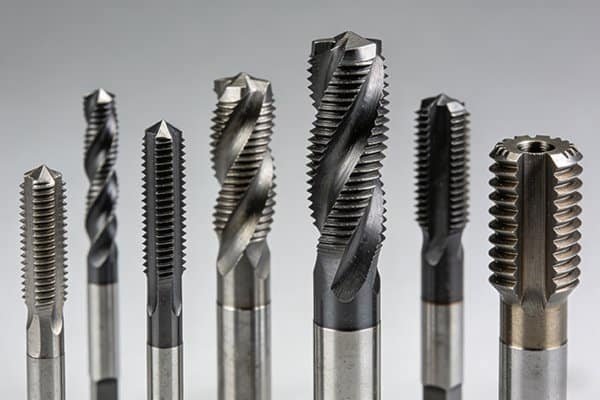
I remember the first time I snapped a tap in an expensive part. The feeling was awful. It took hours to fix, and the whole project was delayed. I learned a hard lesson that day: picking the right tap isn't just a detail, it's the foundation of a successful job. Let’s walk through the simple steps I now use to get it right every single time, so you can avoid the same headaches.
Is My Hole Through or Blind? (This Single Answer Narrows Your Choice by 90%)
You have a hole to thread, but which tap do you grab? The wrong choice leads to clogged chips, a broken tap, and a scrapped part. This is a common workshop problem.
For a through hole (exits the other side), use a spiral point tap. It pushes chips forward and out.1 For a blind hole (stops inside the material), use a spiral flute tap, which pulls chips backward and out of the hole.2
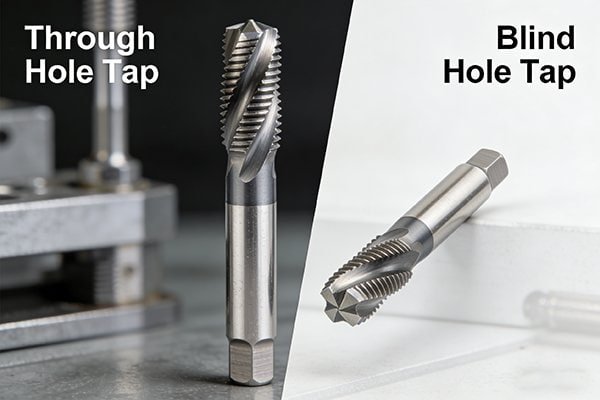
The most important thing about tapping is controlling the chips.3 Chips are the metal shavings created during cutting. If they get stuck, they jam the tap, and the tap breaks. It's that simple. The type of hole you have dictates where the chips need to go. In a through hole, you have an open exit, so pushing the chips forward and out of the way is the most efficient method. But in a blind hole, there's nowhere for the chips to go at the bottom. Pushing them down would be a disaster. You must pull them up and out of the entrance. This single decision—where the chips must go—is the first and most critical step in choosing your tap.
Tap Geometry for Chip Control
| Tap Type | Chip Direction | Best For | Why It Works |
|---|---|---|---|
| Spiral Point Tap | Forward (Down) | Through Holes | The angled "gun tip" actively pushes chips ahead of the tap, keeping flutes clear for coolant and smooth cutting. |
| Spiral Flute Tap | Backward (Up) | Blind Holes | The helical flutes act like an auger, lifting chips up and out of the hole, preventing them from packing at the bottom. |
Next Question: Should I Cut the Threads or Form Them? (The Material Decides)
You need strong, clean threads, but cutting taps can create messy chips. Forming taps are chipless, but will they work on your material? Using the wrong process can lead to weak threads or a broken tool.
Use a cutting tap for most materials like steel and cast iron, which create chips.4 Use a forming (extrusion) tap for ductile materials like aluminum, copper, and low-carbon steel, which can be molded without creating chips.5
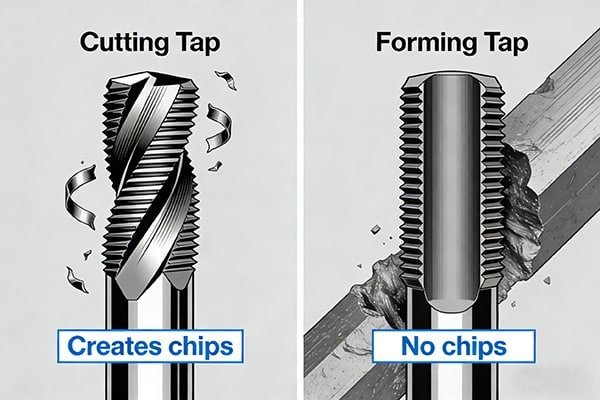
The choice between cutting and forming comes down to your material's properties. Think of it like this: some materials, like hard steel, need to be carved away. That's what a cutting tap does. It has sharp edges that shear off material to create the thread shape. Other materials, like soft aluminum, are more like clay. You can push them into a new shape without removing any material. That's what a forming tap does. It uses pressure to displace the material and "form" the threads. This chipless process creates a stronger thread because the grain structure of the metal isn't cut; it's just rearranged.6 But be careful, using a forming tap on a brittle material like cast iron will just break the tap7.
Cutting vs. Forming Taps: A Quick Guide
| Feature | Cutting Taps | Forming (Extrusion) Taps |
|---|---|---|
| Process | Removes material, creates chips | Displaces material, no chips |
| Best Materials | Most steels, cast iron, titanium | Aluminum, copper, low-carbon steel, some stainless steels |
| Thread Strength | Good | Excellent (uninterrupted grain flow) |
| Pilot Hole Size | Standard drill size | Larger, very precise diameter needed |
| Advantage | Works on a wide range of materials | Faster, stronger threads, no chip problems |
What If I'm Tapping by Hand? (Understanding the Taper, Plug, and Bottoming Trio)
You're trying to tap a hole by hand, but the tap won't start straight. Or worse, it binds up and snaps after just a few turns. This happens when too much force is required.
For hand tapping, use a set of three taps: a taper tap to start the thread, a plug tap to cut it deeper, and a bottoming tap to finish the threads to the bottom of a blind hole.8
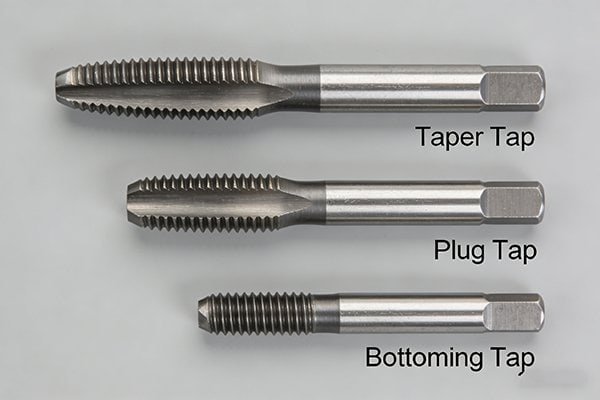
When you use a machine, you have perfect alignment and consistent power. When you're working by hand, you don't. A single tap has to do a lot of work, which makes it hard to control. That's why hand tapping sets were invented. They break the job into three manageable steps. The first tap, the taper tap, has a long, gradual chamfer that makes it very easy to start the hole straight. It only cuts the very beginning of the thread. The second tap, the plug tap, cuts the threads a little deeper. Finally, the bottoming tap, which has almost no chamfer, is used to cut the last few threads at the bottom of a blind hole. This step-by-step process reduces the cutting force at each stage, giving you much more control and drastically reducing the risk of breaking the tap.
The Hand Tapping Trio Explained
| Tap Name | Appearance | Purpose |
|---|---|---|
| Taper Tap | Long chamfer (8-10 threads)9 | Starts the thread easily and ensures straight alignment. |
| Plug Tap | Medium chamfer (3-5 threads) | Cuts the threads deeper after the taper tap has started them. |
| Bottoming Tap | Short chamfer (1-2 threads) | Cuts full threads almost to the very bottom of a blind hole. |
How Do I Match the Tap's Coating and Material to My Job for Longer Tool Life?
Your taps wear out too quickly, costing you money and causing production delays. You know there are different coatings, but they just seem like confusing colors. This uncertainty leads to poor tool life and performance.
Match the tap's coating to the material you're tapping. Use a basic TiN (gold) coating for general-purpose steel, a harder TiCN (blue-gray) for cast iron, and a heat-resistant TiAlN (purple-black) for high-speed tapping or tough alloys.

Think of a tap's coating as its armor. An uncoated tap is just plain tool steel. It works, but it wears down quickly. A coating is a micro-thin layer of a very hard ceramic material that protects the cutting edges. This armor does three things: it increases surface hardness, it reduces friction, and it resists heat10. By reducing friction, the tap cuts more easily and requires less torque. By resisting heat, the cutting edges don't soften and dull during high-speed operations. Choosing the right armor for the battle you're fighting (the material you are tapping) is the key to making your tools last longer, produce better threads, and ultimately save you money. It's a small investment that pays off with every hole you tap.
Common Tap Coatings and Their Uses
| Coating | Color | Properties | Best For |
|---|---|---|---|
| Titanium Nitride (TiN) | Gold | General purpose, good hardness and lubricity. | Carbon steels, alloy steels, stainless steels. |
| Titanium Carbonitride (TiCN)11 | Blue-Gray | Harder and more wear-resistant than TiN. | Cast iron, aluminum alloys, abrasive materials. |
| Titanium Aluminum Nitride (TiAlN)12 | Purple-Black | Excellent heat resistance, maintains hardness at high temps. | High-speed machining, dry tapping, hardened steels, nickel alloys. |
Can You Give Me a Simple Flowchart to Make the Perfect Choice Every Time?
You've learned about hole types, materials, and coatings, but putting it all together on the spot can be stressful. You need a simple, repeatable process to follow so you can choose with confidence every time.
Yes. Follow this four-step process: 1. Is the hole through or blind? 2. Is the material ductile (formable) or not? 3. Combine these answers to pick the basic tap type. 4. Select a coating based on the material.
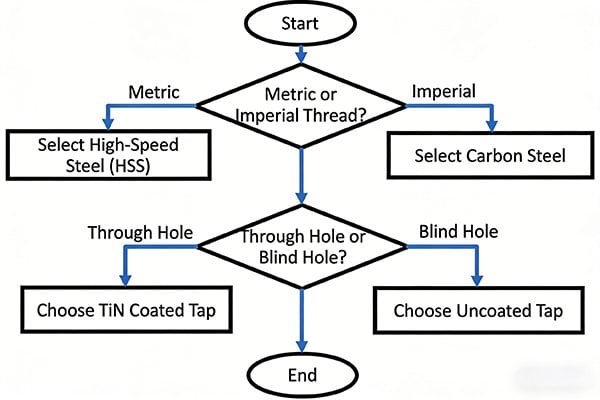
Over the years, I've refined my selection process into a simple mental checklist. This isn't complicated; it's just about asking the right questions in the right order. By breaking it down, you eliminate hundreds of wrong options and quickly zero in on the perfect tool for your specific application. This structured approach removes guesswork and ensures you get consistent, high-quality results. It turns a complex decision into a series of simple choices. I've laid it out below as a step-by-step guide. Follow these steps, and you'll be choosing taps like an expert in no time. It's the same process we use at NV-Tool to advise our B2B clients on the best solutions for their production lines.
Your 4-Step Tap Selection Checklist
Step 1: Identify Hole Type
- Does the hole go all the way through the part?
- YES -> Through Hole. Chips can be pushed forward.
- Does the hole stop inside the part?
- NO -> Blind Hole. Chips must be pulled backward.
Step 2: Identify Material Type
- Is the material ductile (e.g., aluminum, copper, low-carbon steel)?
- YES -> Forming is an option.
- Is the material brittle or hard (e.g., cast iron, high-carbon steel, tool steel)?
- NO -> Cutting is required.
Step 3: Choose the Basic Tap
- Through Hole + Cutting Material: Use a Spiral Point (Gun Tip) Tap.
- Blind Hole + Cutting Material: Use a Spiral Flute Tap.
- Through or Blind Hole + Forming Material: Use a Forming Tap (for best results).
Step 4: Select the Coating
- General Steel: Choose TiN.
- Cast Iron / Abrasive Material: Choose TiCN.
- High-Speed / Hard Materials: Choose TiAlN.
Conclusion
Choosing the right tap is easy. Just identify your hole type, material, and operating conditions. This simple process ensures clean threads, longer tool life, and fewer broken taps every time.
"Chp 05-01 Numerical Control Programming", http://faculty.etsu.edu/hemphill/entc3710/nc-prog/nc-05-01.htm. A machining handbook or educational manufacturing reference can support that spiral-point, or gun-nose, taps are designed to drive chips ahead of the tap and are commonly used for through-hole threading. Evidence role: mechanism; source type: education. Supports: Spiral point taps are appropriate for through holes because their geometry pushes chips forward and out of the hole.. Scope note: The source may describe the general tool geometry and typical application rather than prove optimal performance in every material or machine setup. ↩
"Laboratory Resources - Mechanical & Aerospace Engineering", https://web.mae.ufl.edu/designlab/Lab%20Resources/Lab%20Resources.htm. A neutral machining reference can document that spiral-flute taps lift chips back toward the hole entrance, making them suitable for blind-hole tapping where chips cannot exit through the bottom. Evidence role: mechanism; source type: education. Supports: Spiral flute taps are used for blind holes because their flutes draw chips upward and out of the hole.. Scope note: The support is a general application principle; actual suitability also depends on material, coolant, depth, and machine rigidity. ↩
"[PDF] Experimental investigation of ultrasonic vibration-assisted tapping", http://www.et.byu.edu/~ered/ME482/Paper_Topics/HainingTappingVibrationPaper.pdf. Machining references on tapping can support that chip evacuation is a central factor in tapping reliability because trapped chips can raise torque, damage threads, and contribute to tap breakage. Evidence role: expert_consensus; source type: education. Supports: Chip control is a critical consideration in tapping operations.. Scope note: Calling it the “most important” factor is an editorial emphasis; sources are more likely to establish that chip control is one of several major factors. ↩
"The Ultimate Guide to 10/32 Tap Drill Size: Fast Facts & SEO Tips", https://imba.missouri.edu/10-32-form-tap-drill-size-1744288370.html. A manufacturing or machining reference can support that cutting taps remove material to generate internal threads and are broadly applicable to common materials, including steels and cast irons. Evidence role: definition; source type: education. Supports: Cutting taps remove material and are commonly used for materials such as steel and cast iron.. Scope note: Material-specific recommendations vary by alloy, hardness, hole type, lubrication, and production conditions. ↩
"(PDF) Analysis of form threads using fluteless taps in cast ...", https://www.academia.edu/97768133/Analysis_of_form_threads_using_fluteless_taps_in_cast_magnesium_alloy_AM60_. A technical manufacturing source can support that thread-forming taps plastically displace ductile metals to create threads without chip formation, with common applications in aluminum, copper alloys, and low-carbon steels. Evidence role: mechanism; source type: education. Supports: Forming taps are suitable for ductile materials and create threads by displacement rather than chip removal.. Scope note: The source may identify these materials as common candidates, but form tapping also depends on elongation, hardness, lubrication, and correct pre-hole diameter. ↩
"Performance of Internal Thread Rolling Head and The Mechanical ...", https://www.academia.edu/95911764/Performance_of_Internal_Thread_Rolling_Head_and_The_Mechanical_Properties_of_Rolled_Thread. Research or technical literature on cold-formed internal threads can support that thread forming preserves or redirects material flow rather than cutting it, often improving thread strength or fatigue behavior compared with cut threads in suitable ductile materials. Evidence role: mechanism; source type: paper. Supports: Formed threads can be stronger because material flow is displaced rather than severed.. Scope note: The strength advantage is material- and process-dependent and should not be read as universal for all thread sizes, alloys, or loading conditions. ↩
"The Ultimate Guide to 10x1.5 Tap Drill Size: Precision Tips & Best ...", https://imba.missouri.edu/10x1-5-tap-drill-size-1708009618.html. A machining reference can support that roll or forming taps require ductile work materials and are generally unsuitable for brittle materials such as cast iron, which do not plastically flow adequately during thread formation. Evidence role: expert_consensus; source type: education. Supports: Forming taps are unsuitable or risky in brittle materials such as cast iron.. Scope note: The wording “will just break” is stronger than most sources will state; evidence typically supports unsuitability and high failure risk rather than inevitable breakage. ↩
"TapDrillChart - MEAM.Design", https://medesign.seas.upenn.edu/index.php/Guides/TapDrillChart. A machining or engineering reference can verify the conventional roles of taper, plug, and bottoming hand taps, including starting threads with a longer chamfer and using a bottoming tap to cut closer to the bottom of a blind hole. Evidence role: definition; source type: education. Supports: Taper, plug, and bottoming taps serve different stages in hand tapping.. Scope note: Some modern hand-tapping operations may use fewer taps depending on material, thread depth, and tool design. ↩
"# 10-32 H3, Set of 3 Taper, Plug & Bottoming Chamfer, HSS Hand ...", https://www.globalindustrial.com/p/number-10-32-h3-set-of-3-one-each-taper-plug-and-bottoming-chamfer-hss-hand-tap-ground-rh-4-flutes?srsltid=AfmBOoqJW9_t2Ikf9bViPiUFEDJJjVhcZhfLneo0j6B8o_BLu1sdEzF7. A standards-based or educational machining source can support that taper taps have a relatively long chamfer, commonly described as about eight to ten threads, to ease thread starting and alignment. Evidence role: definition; source type: institution. Supports: Taper taps typically have a long chamfer of about 8–10 threads.. Scope note: Exact chamfer counts can vary by standard, manufacturer, and tap series. ↩
"Coating Cutting Tools with Hard Substance Lowers Friction ...", https://www.academia.edu/63131405/Coating_Cutting_Tools_with_Hard_Substance_Lowers_Friction_Co_efficient_and_Improves_Tool_Life_A_Review. Materials and coating literature can support that hard ceramic tool coatings such as TiN, TiCN, and TiAlN are used to improve wear resistance, reduce friction or adhesion, and maintain cutting performance under elevated temperatures. Evidence role: mechanism; source type: paper. Supports: Tap coatings can improve hardness, reduce friction, and improve heat or wear resistance.. Scope note: The magnitude of each benefit depends on coating composition, deposition method, substrate, work material, lubrication, and cutting parameters. ↩
"(PDF) Wear resistance investigation of titanium nitride-based coatings", https://www.academia.edu/31578985/Wear_resistance_investigation_of_titanium_nitride_based_coatings. A materials or cutting-tool coating reference can support that titanium carbonitride coatings generally have higher hardness and wear resistance than titanium nitride coatings, which explains their use in abrasive machining applications. Evidence role: general_support; source type: paper. Supports: TiCN coatings are typically harder and more wear resistant than TiN and are used where abrasive wear is a concern.. Scope note: Application to cast iron or aluminum alloys is contextual; performance depends on the alloy, cutting speed, lubrication, and whether adhesion or abrasion is the dominant wear mode. ↩
"The Oxidation Behaviour and Notch Wear Formation of TiAlN ... - PMC", https://pmc.ncbi.nlm.nih.gov/articles/PMC8048706/. Coating literature can support that titanium aluminum nitride coatings form thermally stable, oxidation-resistant layers and are commonly used for high-temperature or high-speed machining of difficult materials. Evidence role: mechanism; source type: paper. Supports: TiAlN coatings provide high-temperature performance useful in high-speed machining and difficult materials.. Scope note: The source may support TiAlN’s thermal stability generally, not guarantee superior performance for every hardened steel, nickel alloy, or tapping condition. ↩