Choosing the wrong end mill can ruin your workpiece and waste money. A simple mistake leads to costly delays. But understanding a few key features makes all the difference.
An end mill is a cutting tool used for shaping parts in a milling machine.1 The right one is chosen based on its material, number of flutes, shape, and coating2, which must all match the workpiece material and the desired machining operation for optimal performance and finish.
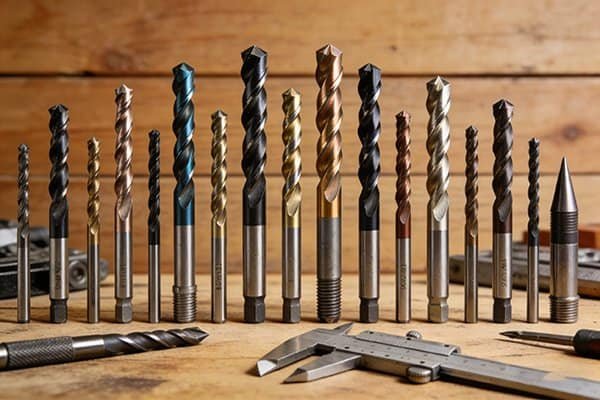
Over my years in the cutting tool business, I've seen countless machine shops struggle with this. A customer in Mexico once called me, completely frustrated. He was trying to machine a simple steel part but was breaking tools one after another. He was using a beautiful, expensive two-flute end mill designed for aluminum. It was the perfect tool for the wrong job. After we switched him to a simple four-flute, TiAlN-coated tool, his problems vanished. This is a common story. Choosing the right tool isn't about finding the "best" one; it's about finding the correct one for your specific task. Let's break down how to do that every single time.
How Does the Shape of a Flute Dictate Your Cutting Speed and Finish?
Slow cutting speeds and a rough finish are common frustrations in any machine shop. These problems increase cycle times and can lead to scrapped parts. It all comes down to chip evacuation.
The shape, or more specifically the helix angle of the flute, controls how quickly chips are removed.3 A high helix angle (like 45°) pulls chips out fast for a great finish in soft materials. A low helix angle (around 30°) provides a stronger edge for tough materials.4
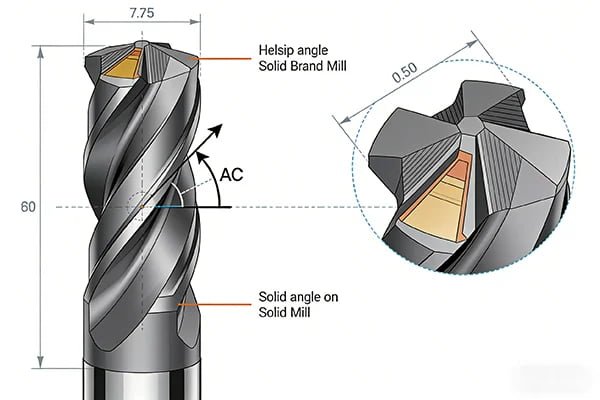
The helix angle is the angle of the cutting edge as it spirals around the tool. Think of it like the threads on a screw. This angle has a direct impact on the cutting action. A higher angle creates a shearing action that is gentler on the material, leading to a better surface finish.5 It also helps to pull chips up and away from the cutting zone, which is critical when machining materials like aluminum that produce long, stringy chips. However, this sharp angle creates a weaker cutting edge. On the other hand, a lower helix angle presents a more direct, stronger cutting edge to the material. This is better for tough or hardened steels where edge strength is more important than a perfect finish during roughing. It creates more cutting pressure and doesn't evacuate chips as efficiently, but the tool will last longer in demanding cuts.
| Helix Angle | Primary Use | Characteristics |
|---|---|---|
| High Helix (35°-60°) | Soft Materials (Aluminum, Brass) | Excellent chip evacuation, superior surface finish, weaker cutting edge. |
| Standard Helix (30°-35°) | General Purpose (Steels, Cast Iron) | Good balance of strength and chip removal. A versatile workhorse. |
| Low Helix (0°-30°) | Hard Materials (Hardened Steel) | Very strong cutting edge, handles high cutting forces, slower chip removal. |
When Should You Use a Square End Mill vs. a Ball Nose?
Are you trying to machine a flat pocket but ending up with rounded corners? Or creating a 3D surface that looks jagged and stepped? Using the wrong tool tip shape is the problem.
Use a square end mill for 2D features like pockets, walls, and slots to create sharp 90-degree corners.6 Use a ball nose end mill for 3D contouring, complex surfacing, and creating smooth fillets, like in mold making.7
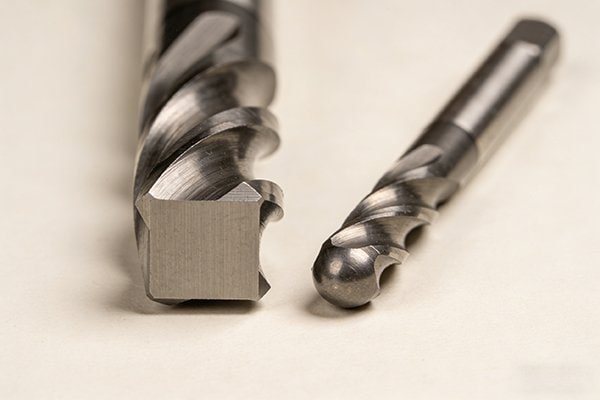
The business end of the end mill determines the shape of the surface you create. The choice here is fundamental to the feature you are machining. A square end mill, also called a flat bottom end mill, is the most common type. Its purpose is to create flat surfaces and sharp, 90-degree transitions between walls and floors. It is the go-to tool for general-purpose milling, including facing, slotting, and profiling.
A ball nose end mill has a fully rounded tip. It has no flat bottom at all. This design makes it perfect for machining complex, three-dimensional curved surfaces. Think of mold and die manufacturing or creating artistic and organic shapes. It's also used for "filleting," which is creating a rounded internal corner. We also have corner radius end mills, which are a hybrid. They are mostly flat on the bottom but have rounded corners. This adds strength to the cutting edge, preventing the sharp corner from chipping under load8, and it leaves a small, strong radius at the bottom of a wall.
| End Mill Shape | Primary Function | Common Applications |
|---|---|---|
| Square End | Creates flat surfaces and sharp 90° corners. | Pocketing, slotting, profiling, facing. |
| Ball Nose | Creates complex 3D curved surfaces. | Mold & die, 3D contouring, surfacing. |
| Corner Radius | A square end with rounded corners for strength. | General milling where a small corner radius is acceptable or desired. |
Is Carbide Always the Best Material, or Can HSS Save You Money?
Many shops default to buying solid carbide tools, thinking they are the best. But then they break an expensive tool on an older, less rigid machine, and the cost adds up quickly.
Carbide is best for high-speed production on rigid CNC machines.9 However, High-Speed Steel (HSS) is tougher, more forgiving, and much cheaper.10 It is an excellent choice for manual mills, less rigid setups, or jobs with heavy vibration where carbide would chip.
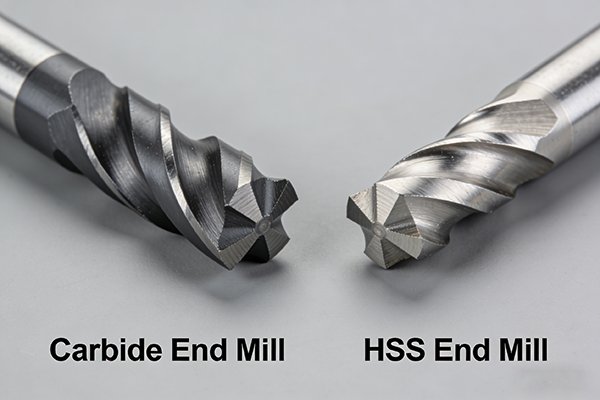
The material of your end mill is a trade-off between hardness, toughness, and cost. Solid carbide is extremely hard and wear-resistant. This hardness allows it to hold a sharp edge and run at very high speeds and feeds, which is why it dominates modern CNC production. But it comes at a price—it's brittle. On a machine that isn't perfectly rigid or in a setup with a lot of vibration, a carbide tool can easily chip or shatter.
High-Speed Steel (HSS) is the opposite. It's not as hard as carbide, so you can't run it as fast. However, it is much tougher and more resistant to shock. It can bend or deflect slightly where carbide would snap. This makes HSS a smart, cost-effective choice for many situations. I often recommend it to job shops with older manual milling machines or for one-off jobs where the cost of a carbide tool isn't justified. It's a forgiving material that can save you a lot of money and headaches if used in the right application.
How Many Flutes Do You Actually Need for Your Material?
Are chips clogging up your tool when cutting aluminum? Or are you getting terrible chatter and a poor finish when milling steel? You might have the wrong number of flutes on your end mill.
Use fewer flutes (2 or 3) for soft materials like aluminum to provide large channels for chip evacuation.11 Use more flutes (4 or more) for harder materials like steel to get a smoother finish, better stability, and longer tool life.12
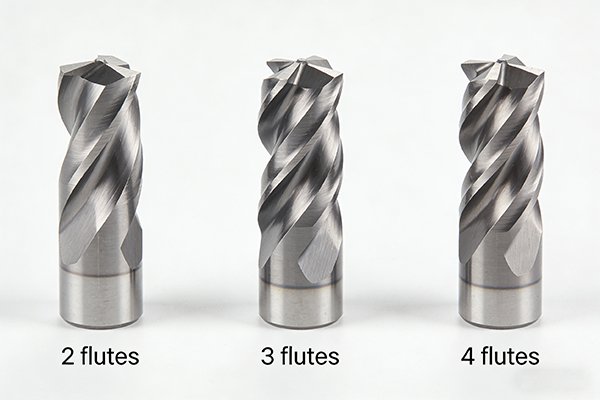
The number of flutes on an end mill is a balance between chip evacuation space and the number of cutting edges. Each flute is a cutting edge, but the space between the flutes, the "flute valley," is what carries the chips away from the workpiece.
When machining soft, gummy materials like aluminum, you produce large, long chips. You need big flute valleys to get those chips out of the way quickly. If they can't escape, they will pack together, break the tool, or ruin the part. That's why 2-flute and 3-flute end mills are standard for aluminum.
When you machine hard materials like steel or stainless steel, the chips are smaller and more brittle. You don't need as much space for chip evacuation. Here, having more flutes is better. A 4-flute or 5-flute end mill will have more cutting edges engaged with the material at any given time. This distributes the cutting load, reduces vibration, and produces a much better surface finish. More flutes also mean you can increase your feed rate, as each tooth has to do less work.
| Flute Count | Best For | Why? |
|---|---|---|
| 2-Flute | Aluminum, Plastics, Wood | Maximum space for chip evacuation. Ideal for slotting. |
| 3-Flute | Aluminum, Steels | A versatile option. Better finish than 2-flute, better chip room than 4-flute. |
| 4+ Flutes | Steels, Stainless Steels, Hard Metals | Smoother finish, better stability. Ideal for peripheral milling and finishing. |
What Does a Coating Really Do for Your End Mill?
Are your tools wearing out way too fast, even on simple jobs? A worn-out tool leads to poor finishes and inaccurate parts. You might be skipping the most important performance-enhancing feature.
A coating is like armor for your end mill. It adds hardness for wear resistance, lubricity to reduce friction, and thermal stability to handle heat. This lets you cut faster, run longer, and dramatically extend the life of your tool.
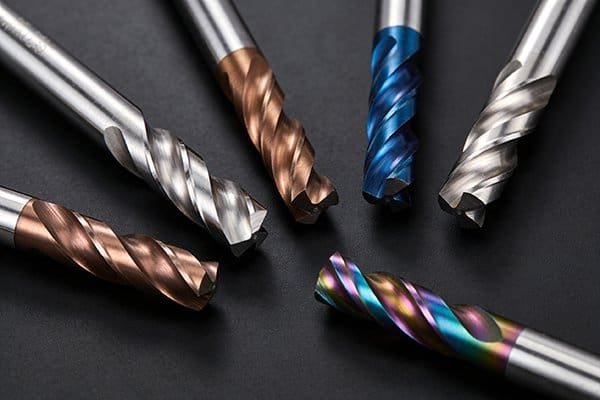
An uncoated "bright" end mill is perfectly fine for some materials, especially non-ferrous ones like aluminum where you want to avoid any chemical reaction. But for most other materials, a coating provides a huge advantage. These micro-thin layers of ceramic material are applied to the tool's surface using a PVD (Physical Vapor Deposition) process. Each coating has different properties.
The classic gold-colored TiN (Titanium Nitride) is a great general-purpose coating. But the most common one we sell today is TiAlN (Titanium Aluminum Nitride). This dark purple/black coating forms a layer of aluminum oxide at high temperatures, which acts as a thermal barrier. This incredible heat resistance makes it perfect for high-speed machining of steel and stainless steel, even without coolant. Other specialized coatings like AlCrN are great for "gummy" materials that tend to stick to the tool, while DLC (Diamond-Like Carbon) offers extreme hardness and lubricity for machining abrasive materials like graphite and high-silicon aluminum. A good coating is a small investment that pays for itself many times over in tool life and performance.
How Do You Combine These Choices for a Perfect First Cut?
Feeling overwhelmed by the choices of flutes, materials, shapes, and coatings? It's easy to get lost. But making the right combination is simpler than you think if you follow a logical process.
Start with your workpiece material to pick the flute count and tool material. Next, choose the tip shape based on the geometry you need to create. Finally, select a coating that matches your material for maximum performance and tool life.
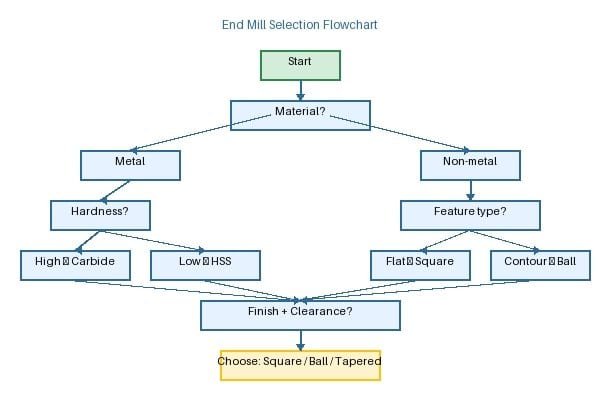
Let's walk through it with a couple of real-world examples from our customers. A client in Poland needed to machine a deep pocket in a block of aluminum.
- Material: Aluminum. It's soft and produces big chips. This immediately tells us we need good chip evacuation.
- Flutes & Tool Material: We need big flute valleys, so a 2 or 3-flute end mill is the answer. We'll use solid carbide for high-speed performance.
- Shape: It's a pocket with flat walls and a flat floor. That means we need a square end mill.
- Coating: To prevent the aluminum from sticking to the tool, we can either use an uncoated (bright) tool or a specialized slick coating like DLC. The perfect tool: A 3-flute, uncoated solid carbide square end mill.
Now, consider another customer in the automotive sector in Brazil who was finishing a 3D mold cavity in P20 steel.
- Material: P20 Steel. It's hard and requires a good finish.
- Flutes & Tool Material: For a good finish in steel, we want more cutting edges. A 4 or 5-flute end mill is best. We must use solid carbide for its wear resistance.
- Shape: It's a complex 3D surface. This is a job for a ball nose end mill.
- Coating: We'll be generating a lot of heat. A TiAlN coating is perfect for handling high temperatures in steel. The perfect tool: A 4-flute, TiAlN-coated solid carbide ball nose end mill.
Conclusion
Choosing the right end mill is a process of matching the tool to the task. By considering material, flutes, shape, and coating, you can ensure efficient, accurate cuts and longer tool life.
"Milling cutter - Wikipedia", https://en.wikipedia.org/wiki/Milling_cutter. A machining reference or engineering encyclopedia defines an end mill as a rotary milling cutter used to remove material and produce features such as slots, pockets, profiles, and contoured surfaces. Evidence role: definition; source type: encyclopedia. Supports: An end mill is a cutting tool used for shaping parts in a milling machine.. ↩
"[PDF] Evaluation of End mill Coatings Federal Manufacturing ... - OSTI", https://www.osti.gov/servlets/purl/885182. A manufacturing or machining handbook explains that end-mill selection depends on cutter substrate, geometry, flute count, coating, work material, and operation type; this supports the selection framework rather than proving a single universal rule. Evidence role: expert_consensus; source type: education. Supports: The right end mill is chosen based on its material, number of flutes, shape, and coating.. Scope note: Selection criteria vary by machine rigidity, coolant, toolpath, and manufacturer-specific geometry. ↩
"[PDF] Helical - MACHINING GUIDEBOOK", https://web.mae.ufl.edu/designlab/Advanced%20Manufacturing/Helical_Machining_Guidebook.pdf. Machining literature describes helix angle as a cutter-geometry parameter affecting chip flow direction, cutting forces, and evacuation in milling operations. Evidence role: mechanism; source type: paper. Supports: The helix angle of the flute influences how chips are removed from the cutting zone.. Scope note: The exact evacuation rate also depends on feed, speed, depth of cut, coolant, flute polish, and toolpath engagement. ↩
"Choosing Endmill Helix Angles", https://community.carbide3d.com/t/choosing-endmill-helix-angles/24942. Machining references describe lower-helix or less aggressively raked milling cutters as providing greater edge support and rigidity, making them suitable where edge strength is important. Evidence role: mechanism; source type: education. Supports: A lower helix angle can provide a stronger cutting edge for tougher materials.. Scope note: The numerical boundary for “low” helix angle is convention-dependent, and optimal geometry depends on the alloy, hardness, and operation. ↩
"Figure 5 - from INFLUENCE OF DIFFERENT CUTTER HELIX ANGLE", https://www.academia.edu/figures/50892967/figure-6-maximum-surface-roughness-for-different-of-cutter. Studies of milling cutter helix geometry report that higher helix angles can reduce cutting-force fluctuation and improve cutting action, which is associated with better surface finish under suitable conditions. Evidence role: mechanism; source type: paper. Supports: A higher helix angle can create a more shearing cutting action and contribute to improved surface finish.. Scope note: Surface finish is also affected by runout, tool wear, feed per tooth, work material, coolant, and machine dynamics. ↩
"Square End Mills Manufacturer & Supplier - ONMY Tools", https://onmytoolings.com/carbide-end-mill-supplier/square-end-mill/. Manufacturing-process references describe flat or square-end mills as cutters used to machine flat-bottomed pockets, slots, shoulders, and profiles with square internal features where tool access permits. Evidence role: definition; source type: education. Supports: Square end mills are used for pockets, walls, slots, and 90-degree corner features.. Scope note: Actual internal corner sharpness is limited by cutter radius and machining access; perfectly sharp internal corners are often not possible in all geometries. ↩
"Surfacing Ball Endmills - CNC Machining", https://www.practicalmachinist.com/forum/threads/surfacing-ball-endmills.237437/. Machining and CAD/CAM references identify ball-end mills as common tools for three-dimensional contour milling and die or mold surface finishing because the hemispherical end can follow curved surfaces. Evidence role: general_support; source type: education. Supports: Ball nose end mills are used for 3D contouring, complex surfacing, smooth fillets, and mold-making operations.. Scope note: The best tool for a mold surface also depends on step-over, scallop height, tool diameter, and finishing strategy. ↩
"[PDF] The Effects of Corner Radius and Edge Radius on Tool Flank Wear", https://www.me.mtu.edu/~wjendres/Papers/Endres%20%26%20Kountanya%20%28JMP%202002%29.pdf. Tool-geometry literature notes that adding a corner radius or edge preparation can reduce stress concentration at the cutter corner and improve resistance to chipping in milling. Evidence role: mechanism; source type: paper. Supports: A corner radius can strengthen the cutting edge and reduce corner chipping under load.. Scope note: The amount of benefit depends on radius size, tool material, coating, cutting load, and workpiece material. ↩
"[PDF] CUTTING TOOL TECHNOLOGY", https://www.egr.msu.edu/~pkwon/me478/cuttingtool.pdf. Machining handbooks and materials references describe cemented carbide tools as having high hot hardness and wear resistance, enabling higher cutting speeds than high-speed steel in rigid machine-tool setups. Evidence role: expert_consensus; source type: education. Supports: Carbide tools are well suited to high-speed production on rigid CNC machines.. Scope note: “Best” is application-specific and depends on interrupted cuts, tool geometry, work material, coolant, and economic constraints. ↩
"A Comprehensive Guide To Pros and Cons of Carbide Tools and HSS", https://tjgrinding.com/blog-post/comprehensive-guide-pros-and-cons-carbide-tools-and-hss. Materials references characterize high-speed steel as tougher and less brittle than cemented carbide, while cost comparisons in machining texts generally describe HSS tools as less expensive than solid carbide tools. Evidence role: expert_consensus; source type: education. Supports: High-Speed Steel is generally tougher, more forgiving, and cheaper than carbide for cutting tools.. Scope note: Relative cost varies by tool size, grade, coating, supplier, and market conditions. ↩
"Do 3-Flute End Mills Really Dominate Aluminum?", https://www.ksptg.com/learning/3-flute-end-mills-aluminum/. Machining references explain that lower-flute-count end mills provide larger flute spaces for chip evacuation, a feature commonly used when milling aluminum and other materials that generate larger chips. Evidence role: mechanism; source type: education. Supports: Fewer flutes provide larger chip channels and are commonly used for aluminum and similar soft materials.. Scope note: High-efficiency aluminum tools may use specialized geometries, so flute count alone does not determine performance. ↩
"4 Flute End Mill Uses for Steel & Stainless Steel", https://www.cutterbest.com/4-flute-end-mill/. Machining guidance commonly states that higher-flute-count end mills increase the number of cutting edges engaged and can improve finish and stability in steel finishing operations when chip evacuation is adequate. Evidence role: general_support; source type: education. Supports: More flutes are often used for harder materials such as steel to improve finish, stability, and tool life.. Scope note: Tool life and finish also depend on feeds, speeds, radial engagement, coating, tool runout, and machine rigidity. ↩