Struggling with drilling hardened steel? Bits wearing out too fast or breaking? It's a common problem that costs time and money. We have the solution.
A top-quality carbide drill bit for hardened steel1 features a high-hardness substrate2, a heat-resistant PVD coating3, a specialized point geometry4 for stability, and negative rake angles5. These elements combine to withstand extreme pressure and heat, ensuring precision and long tool life.
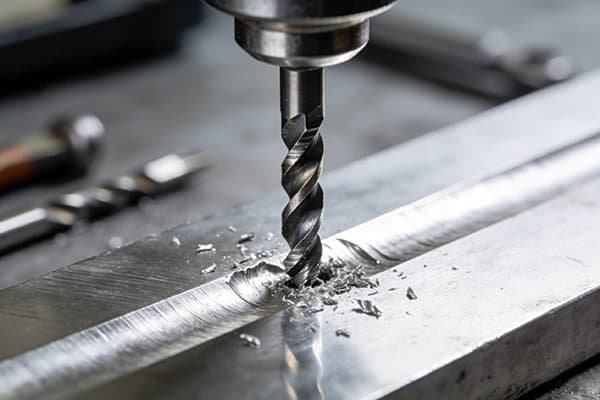
I've been in this industry for over a decade, and I've seen countless shops struggle with this exact issue. It’s not just about buying any carbide drill; it’s about understanding why certain drills perform better than others. Let's break down the details so you can make an informed choice and get the job done right the first time. The journey to perfect holes in tough materials starts now.
What makes drilling hardened steel a unique challenge?
Facing extreme heat and abrasion6 when drilling tough materials? This leads to rapid tool wear7 and poor hole quality, halting your production line.
Drilling hardened steel (typically above HRC45) is challenging due to its extreme hardness, which generates immense heat and pressure at the cutting edge. This causes rapid tool wear7, potential bit failure, and work hardening8 of the material, making subsequent machining even more difficult.
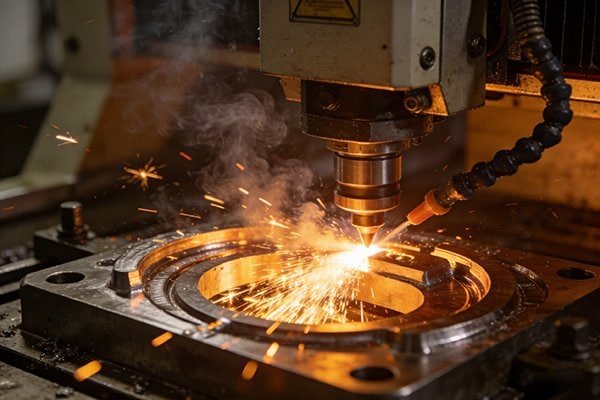
The core problem is simple physics. Hardened steel resists penetration. This resistance creates friction, which turns into incredible heat right at the tip of your drill. We're talking about temperatures that can soften a standard high-speed steel (HSS) bit in seconds. This is where carbide, with its excellent hot hardness, becomes essential. The second problem is abrasion. The microstructure of hardened steel acts like fine sandpaper against the cutting edge, literally grinding it away. This leads to a dull drill, poor performance, and eventually, failure. Finally, there's the issue of work hardening8. If your drill bit isn't cutting cleanly, the heat and pressure can make the surface of the hole even harder than it was before you started. It's a vicious cycle that can quickly destroy your tool and your workpiece.
Key Challenges Summarized
| Challenge | Description | Impact on Machining |
|---|---|---|
| Extreme Hardness | Resists cutting forces, requiring a much harder tool material. | Causes high tool pressure and potential chipping of the cutting edge. |
| High Heat Generation | Intense friction at the tool-workpiece interface. | Can lead to tool softening, coating failure, and poor hole quality. |
| Abrasive Wear | The material's microstructure grinds away the cutting edge. | Rapidly dulls the bit, drastically reducing effective tool life. |
| Work Hardening | The material becomes harder during the drilling process. | Makes continued cutting difficult and can cause tool breakage. |
What are the key technical features to look for?
Confused by all the technical specs for drill bits? Choosing the wrong one means wasted money and broken tools. Let's simplify what really matters for success.
Look for a micro-grain carbide substrate9 for toughness and hardness. A high-performance coating like TiAlN or AlCrN is essential for heat resistance. A self-centering point10 (e.g., 140° split point) and a reinforced web11 provide stability and strength for hard materials.
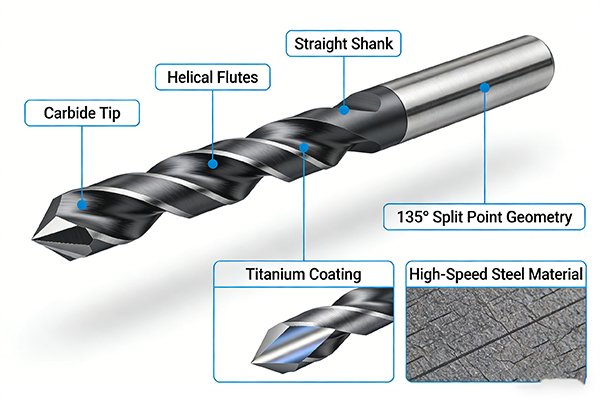
Let's get into the specifics of what makes a great drill bit for this job. Think of it as a system where every part has a critical role. The foundation is the substrate. For hardened steel, we use micro-grain or ultra-fine grain carbide. This gives us the best combination of hardness to resist wear and toughness to prevent the cutting edge from chipping under immense pressure. Next is the coating, which acts as a heat shield. A coating like TiAlN (Titanium Aluminum Nitride) is crucial. When it heats up during cutting, it forms a microscopic layer of aluminum oxide. This layer is incredibly hard and acts as a thermal barrier, protecting the carbide underneath from the extreme temperatures. Finally, the geometry dictates how it cuts. A 140° point angle with a split point design helps the drill to self-center, preventing "walking" and reducing the thrust needed to start the hole. A reinforced web11 and shorter flute length increase the drill's rigidity, preventing it from flexing and breaking under load.
Anatomy of a High-Performance Drill Bit
| Feature | Why It Matters for Hardened Steel | Our Recommendation |
|---|---|---|
| Substrate | High hardness and toughness to resist wear and chipping. | Micro-grain Tungsten Carbide (WC-Co). |
| Coating | Provides a thermal barrier and reduces friction. | TiAlN, AlCrN, or similar advanced PVD coatings. |
| Point Angle | 135°-140° for better centering and reduced thrust force. | 140° Split Point or 4-Facet Point Geometry. |
| Flute Design | Shorter flutes for increased rigidity and stability. | Straight or low-helix flutes to handle short, brittle chips. |
How can you maximize the performance and life of your bit?
Are your expensive drill bits wearing out prematurely? This waste cuts into your profits. You can extend their life with the right techniques and setup.
To maximize tool life, use a rigid machine setup and high-quality tool holders12 to minimize vibration. Apply the correct cutting speeds and feeds13, and use ample coolant (or MQL) to manage heat. Peck drilling can also help with chip evacuation in deep holes.
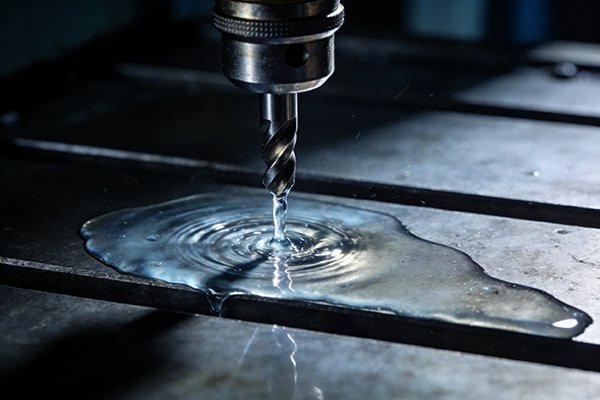
Buying a great drill bit is only half the battle. How you use it is just as important. In my experience, customers can double their tool life just by making a few simple adjustments. First, rigidity is king. Your machine, your workpiece clamping, and your tool holder must be rock-solid. Any vibration acts like a tiny hammer blow to the cutting edge, and it will cause premature failure, especially in brittle carbide. Second, you must use the recommended speeds and feeds. Running too fast generates excessive heat, burning up the coating and softening the substrate. Running too slow can cause the tool to rub instead of cut, leading to work hardening8 and tool failure. Third, coolant is your best friend. It does two critical things: it cools the cutting zone and it flushes away chips. For hardened steel, high-pressure through-coolant is ideal, but even generous flood coolant is far better than drilling dry.
Best Practices for Drilling Hardened Steel
| Practice | Rationale | Practical Tip |
|---|---|---|
| Secure Clamping | Minimizes vibration, which is a primary cause of tool failure. | Use a high-quality hydraulic or milling chuck. |
| Use Correct Parameters | Balances cutting efficiency with tool life and prevents heat damage. | Start with our recommendations and adjust based on results. |
| Ample Coolant | Manages extreme heat and evacuates abrasive chips effectively. | Use through-coolant if available. Otherwise, use flood coolant. |
| Peck Drilling | Helps break chips and clear them from deep holes to prevent packing. | Use for holes deeper than 3 times the drill diameter. |
Which drill bit series is the best fit for your application?
Overwhelmed by different drill bit series? Choosing the wrong one for your specific job leads to inefficiency, poor results, and wasted money. Let's find your perfect match.
For general-purpose hardened steel drilling up to HRC55, our S680 coated series14 is ideal. For higher hardness (HRC55-65) or high-volume production, the H680 series15 with its advanced AlCrN coating offers superior heat resistance and extended tool life for maximum performance.
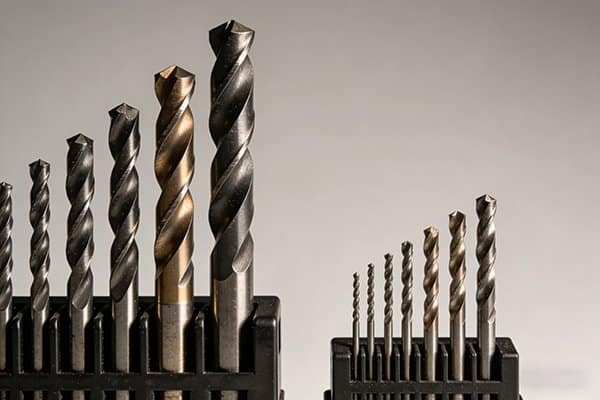
At NV-Tool, we have developed specific solutions because we know one size does not fit all. Let's say you're a mold maker working on P20 or H13 steel, typically in the HRC48-52 range. Our S680 Series is your go-to workhorse. It features a tough micro-grain carbide substrate9 and a versatile TiAlN-based coating that provides excellent performance and great value. It is the perfect choice for job shops and general manufacturing environments. Now, if you are in the high-performance automotive or aerospace sector, drilling materials over HRC60, you need something more robust. That's where our H680 Series comes in. It uses an even finer grain carbide for higher wear resistance and a more advanced AlCrN coating. This coating is engineered for extreme heat, giving you longer life and allowing for higher cutting speeds. It's the choice for when you need to push the limits and maximize productivity on the toughest jobs.
Choosing Your NV-Tool Drill Series
| Series | Target Hardness | Coating | Ideal Application | Key Benefit |
|---|---|---|---|---|
| S680 Series | HRC 45-55 | TiAlN-based | General mold & die, machine components | Excellent balance of performance and cost-effectiveness. |
| H680 Series | HRC 55-65+ | Advanced AlCrN | High-volume production, aerospace parts | Maximum heat resistance and extended tool life. |
| Custom Solutions | Any | Application-Specific | Unique materials or complex hole requirements | Tailored geometry and coating for your exact needs. |
Conclusion
Choosing the right carbide drill for hardened steel involves understanding the material, bit features, and proper technique. With the right tool, you can achieve precision, efficiency, and profitability.
Explore the advantages of carbide drill bits, including durability and precision, to enhance your drilling experience. ↩
Learn about high-hardness substrates and how they improve tool performance and longevity. ↩
Discover how heat-resistant PVD coatings protect drill bits from wear and extend their life. ↩
Understand the importance of point geometry in achieving better drilling accuracy and efficiency. ↩
Find out how negative rake angles contribute to stability and cutting efficiency in drilling. ↩
Explore the challenges posed by heat and abrasion in drilling hardened materials. ↩
Learn about the factors leading to rapid tool wear and how to mitigate them. ↩
Understand work hardening and its impact on drilling performance and tool life. ↩
Discover the benefits of micro-grain carbide substrates for enhanced toughness and hardness. ↩
Explore the benefits of self-centering points for improved drilling accuracy. ↩
Understand how a reinforced web enhances drill stability and strength. ↩
Learn how high-quality tool holders minimize vibration and improve tool life. ↩
Discover the importance of proper cutting speeds and feeds for optimal drilling performance. ↩
Discover the features and applications of the S680 coated series for general-purpose drilling. ↩
Explore the advanced features of the H680 series designed for high-performance applications. ↩